

11 Signs You Have an Energetic Cord With Someone

If you're here, you probably already suspect the answer. Something about this connection doesn't feel finished, even though the relationship, on paper, might be. You're not imagining it, and you're not "too sensitive." Within energetic and folk-spiritual practice, an energetic cord describes exactly this: a felt attachment that lingers between two people after intimacy or intense shared experience, independent of whether contact has continued. Below are the eleven signs that tend to show up most reliably, what they usually mean, and how to tell whether what you're carrying is worth releasing.
What Is an Energetic Cord, Really?
Before the list, it's worth being honest about where this concept comes from, because most sources online skip this entirely. The specific language of "energetic cords" as it's used today — invisible threads connecting people's energy fields, formed through intimacy and severed through intentional ritual — is largely a 20th-century development, popularized through Theosophy and the broader New Age movement rather than handed down from a single ancient tradition. The Theosophical Society, founded in the late 1800s, is where concepts like the "aura" and "etheric body" entered Western spiritual vocabulary in something close to their current form, later absorbed and reshaped by the New Age movement of the 1970s onward.
That doesn't make the experience less real or less worth taking seriously. Many older, genuinely ancient traditions independently describe something adjacent — prana in Vedantic thought, qi in Chinese medicine, the idea of shared breath and life-force running between people. What's honest to say is that the specific cord framework, as most people encounter it today, is a relatively modern synthesis, not a single unbroken ancient practice. We think that distinction matters. You deserve a clear-eyed relationship with the tools you're using, not a mythologized one.
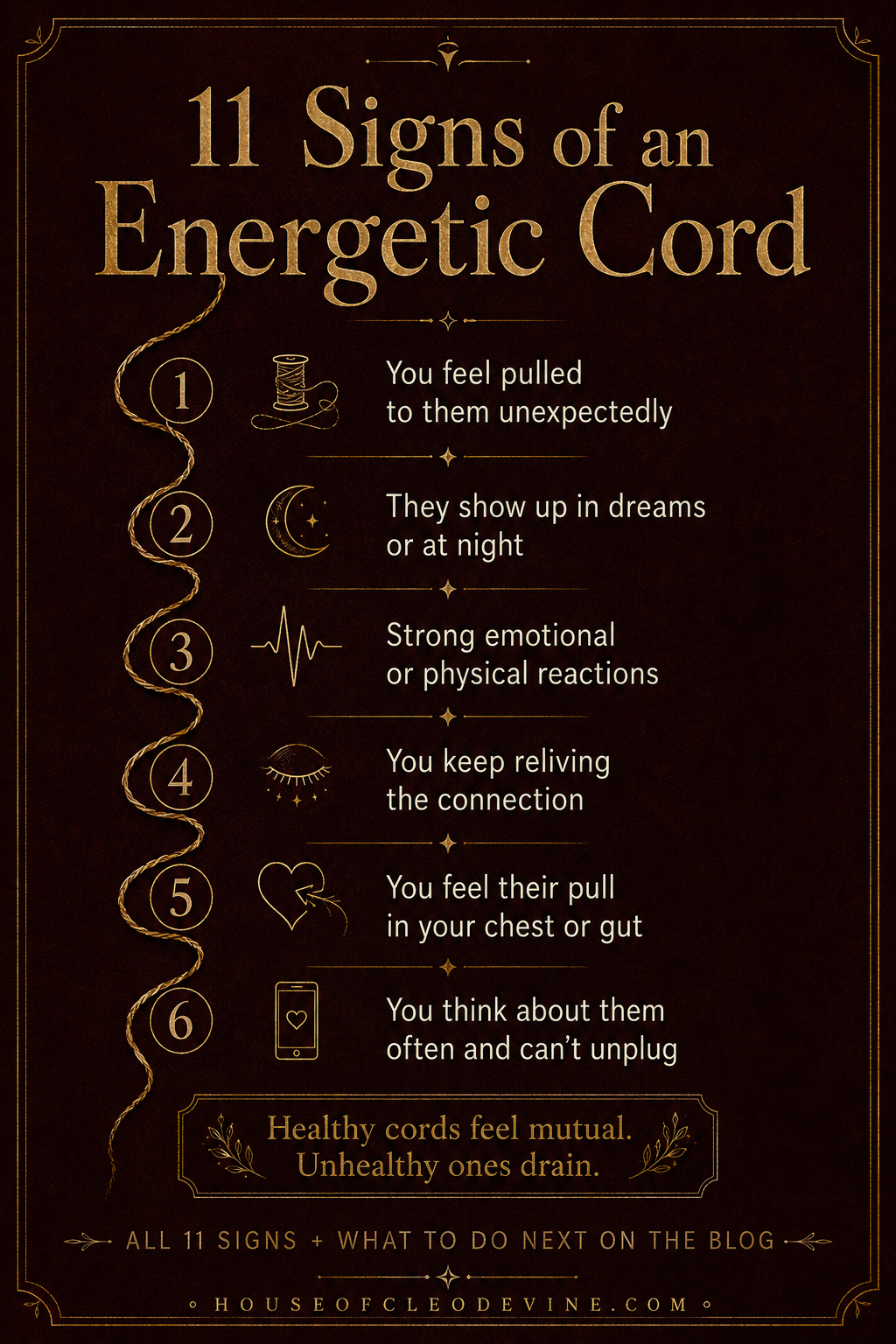
11 Signs You May Have an Energetic Cord With Someone
1. You think about them even when you actively don't want to. Not wistful, occasional memory — a genuinely intrusive quality, where the thought arrives uninvited and interrupts whatever you were actually doing.
2. Your mood shifts around specific times connected to them. Full moons, anniversaries, the date you met, the date you broke up. If your emotional weather reliably changes around these markers without conscious cause, that's a commonly cited sign of an active cord.
3. You feel their emotions without being told anything. A sudden wave of sadness, anxiety, or unease that doesn't match your day, which later turns out to line up with something happening in their life.
4. Vivid or recurring dreams involving them. Especially dreams that replay old conversations, invent new ones, or place you back together, even when you have no conscious desire to reconcile.
5. A physical sensation when you think of them or hear their name. Tightness in the chest, a drop in the stomach, a lump in the throat. Practitioners generally interpret this as the cord's attachment point in the body, most often located at the heart or solar plexus.
6. Lingering guilt or a sense of responsibility for their wellbeing. Even after the relationship has clearly ended, a nagging feeling that you owe them something, or that their happiness is still partly your job.
7. Sudden fatigue or heaviness with no clear physical cause. Especially after thinking about them intensely, or after an interaction, even a brief or minor one.
8. A magnetic pull to check on them or reach out. This can show up as social-media checking, drafting texts you don't send, or a compulsive need to know what they're doing, even when you have no intention of resuming contact.
9. Triggers that feel disproportionate to the situation. A small, unrelated event — a song, a smell, a stranger who resembles them — sets off a reaction that feels bigger than the moment warrants.
10. Thinking of them right before they reach out. The "I was just thinking about you" phenomenon. This is one of the most commonly reported cord experiences, and one of the hardest to explain through coincidence alone when it happens repeatedly.
11. Release practices help, but only temporarily. A salt bath, a journaling session, or a short visualization brings real relief, but the pull returns within days. This usually means there's a cord present that a full, intentional release ritual — rather than everyday energetic hygiene — is better suited to address.
Healthy Cords vs. Unhealthy Cords
Not every cord is a problem, and this is a distinction most lists like this one skip entirely. Cords form through any significant intimacy, closeness, or shared experience — they're a normal and often positive part of how humans stay connected to people they love. A cord with a parent, a close friend, or a healthy partner can feel steady, warm, and mutual rather than draining.
The signs above become worth addressing specifically when the cord feels one-directional (you're giving more energy than you're receiving, or vice versa), when it's tied to a relationship that ended painfully or was unhealthy, or when it's actively interfering with your ability to be present in your current life. A cord isn't inherently something to fear. It becomes something worth releasing when it's costing you more than it's giving.
Signs It's Time to Actually Cut the Cord
If you recognized several of the eleven signs above, and the connection is one you'd genuinely like to be free of (not one you're ambivalent about, which is its own separate conversation), it's generally time to move from awareness into release work when:
The signs have been consistent for weeks or months, not just a rough day or two
Everyday practices (journaling, salt baths, simple visualization) bring only short-lived relief
The connection is actively affecting your sleep, focus, or new relationships
You've done the emotional processing — grieving, understanding, accepting — and the pull is still there anyway
That last point matters. Cord work tends to be most effective after some emotional processing has happened, not as a substitute for it. If you haven't yet sat with the grief or clarity the relationship's ending calls for, that's worth doing alongside, not instead of, any ritual release.
Frequently Asked Questions
Can you have an energetic cord with someone you were never romantically involved with? Yes. Cords can form through any relationship involving emotional intensity, caretaking, trauma, or deep vulnerability — family members, close friends, even a particularly intense working relationship.
Do both people feel the cord, or just one? Within the framework, cords are typically understood to run both directions, though people vary widely in how consciously they notice them. One person feeling it strongly while the other seems unaffected is common and doesn't mean the connection isn't real.
How many of these signs do I need to have for it to count as a cord? There's no strict threshold. A few consistent, persistent signs matter more than checking every box occasionally. Trust the pattern over any single symptom.
Is it possible to have an energetic cord and also just be grieving the relationship? Very possible, and very common. The two often coexist, and it's worth reading through how to tell them apart if you're not sure which is primary for you.
Will cutting the cord make me stop caring about the person? No. Cord work is about releasing the compulsive, draining pull, not the memory, the love, or the meaning the relationship held. Most people describe feeling more at peace with the person, not less connected to their own history.
How long does it take for a cord to fully release? It varies. Some people feel an immediate shift after a single intentional release; others notice a gradual lightening over days or weeks. If the pull returns strongly and repeatedly, it may be worth a deeper session rather than repeating a quick self-guided practice.
You don't need every sign on this list to know something is still active. Trust what your body has already been telling you. If it's time to actually release it rather than just name it, that's the next real step, not more analysis.
If several of these signs sound familiar, Energy Cleanse vs. Cord Cutting can help you figure out exactly which kind of release fits what you're carrying, and the Cord Cutting Session is built for a connection this specific and persistent.
Further Reading From House of Cleo Devine
How to Cut Energetic Cords and Heal Soul Ties After a Breakuphttps://www.houseofcleodevine.com/the-archive/why-you-still-feel-energetically-connected-after-a-breakupThe practical next step for readers ready to move from recognizing signs into ritual release.
The Difference Between an Energy Cleanse and a Cord Cutting (And When You Need Each One)https://www.houseofcleodevine.com/the-archive/the-difference-between-an-energy-cleanse-and-a-cord-cutting-and-when-you-need-each-oneHelps readers who recognize multiple signs decide which specific service fits.
Grief, Trauma Bonding, or Energetic Cord? How to Tell What You're Actually Feelinghttps://www.houseofcleodevine.com/the-archive/grief-trauma-bond-or-energetic-cordFor readers unsure whether what they're carrying is primarily a cord or something layered with grief or a trauma-bond pattern.
Why Can't I Stop Thinking About My Ex? The Spiritual Side of Energetic Attachmenthttps://www.houseofcleodevine.com/the-archive/why-cant-stop-thinking-about-exGoes deeper into sign #1 specifically, combining the neuroscience and the energetic framing.
5 Signs You're Carrying Energy That Isn't Yours (And How to Clear It Safely)https://www.houseofcleodevine.com/the-archive/5-signs-youre-carrying-energy-that-isnt-yours-and-how-to-gently-clear-itFor readers whose heaviness feels more general than tied to one specific person.






















Reputable Sources
Encyclopaedia Britannica — Theosophy: Definition, Beliefs, History, & Facts https://www.britannica.com/topic/theosophy
MIT Press Reader — The Long History of the Human Aura https://thereader.mitpress.mit.edu/the-long-history-of-the-human-aura/
Christian Research Institute — Enhancing Your Energy the New Age Way: Understanding Auras, Chakras, and Qi https://www.equip.org/articles/enhancing-your-energy-the-new-age-way-understanding-auras-chakras-and-qi/
Wikipedia — New Age (for movement dating and general historical framing only; verify claims against primary sources for anything load-bearing) https://en.wikipedia.org/wiki/New_Age