

Why Can't I Stop Thinking About My Ex? The Spiritual Side of Energetic Attachment

You've tried distraction. You've tried journaling, deleting photos, a new hobby, three episodes of something loud enough to drown out your own head. And still, somehow, mid-grocery-run or right before sleep, they're just there again, uninvited. If you've started to wonder whether something is wrong with you, here's the direct answer: no. What you're describing has a real, measurable basis in how your brain processes loss, and for many people, a spiritual dimension worth taking seriously alongside it. Neither cancels the other out. Let's walk through both, so you understand what's actually happening and what genuinely helps.
What's Actually Happening in Your Brain When You Can't Stop Thinking About Someone
The most direct evidence here comes from a 2010 neuroimaging study led by biological anthropologist Dr. Helen Fisher at Rutgers University, published in the Journal of Neurophysiology. Researchers used fMRI to scan the brains of people who had recently been rejected by a partner but reported still being intensely in love with them, studying participants who alternately viewed a photograph of the person who had rejected them and a photograph of a familiar, neutral individual</cite>. When looking at the photo of their ex, activation showed up in areas associated with gains and losses, craving, and emotion regulation, including the ventral tegmental area that controls motivation and reward and is already known to be involved in feelings of romantic love.
The same study found activity in the nucleus accumbens and orbitofrontal cortex — regions associated with craving and addiction, specifically the same dopaminergic reward circuitry evident in cocaine addiction — alongside the insular cortex and anterior cingulate, areas associated with physical pain and distress. In plain terms: when you think about an ex you're not over, your brain lights up in the same places it would during a craving for a substance, at the same time it's registering something close to physical pain. That's not a metaphor. It's what the scan showed.
There's a genuinely hopeful piece of this research too. Researchers found that the greater the number of days since the rejection, the less activity there was in the brain region associated with attachment when participants viewed the same photo. Time doesn't erase the memory, but it does measurably quiet the neurological pull — which is worth knowing on the nights it doesn't feel like that could possibly be true.
Why This Feels Like Addiction (Because, Neurologically, It Kind Of Is)
This isn't Fisher's only finding on the subject. Her broader body of research on romantic love found that people who are passionately in love show many of the basic symptoms of addiction, including craving, tolerance, emotional and physical dependence, withdrawal, and relapse. That framework explains a lot of what feels so disorienting about obsessive post-breakup thinking: the compulsive checking, the relief of seeing their name pop up and the crash after, the way "just one text" can feel like the only thing that will make the craving stop. You're not weak-willed. You're experiencing something with real neurochemical weight, in a reward system that evolved specifically to keep you pair-bonded.
This is also where it's worth pausing to distinguish two different experiences that get lumped together. Occasional, wistful thoughts about an ex are a normal part of healing and don't need intervention. But if the thinking has become compulsive — if you're checking their social media multiple times a day, texting and immediately regretting it, or unable to concentrate because your mind keeps circling back — that pattern resembles compulsive behavior more than ordinary longing, and it responds better to structure and support than to willpower alone.
The Spiritual Framework: What "Energetic Attachment" Means
Within contemporary energetic and folk-spiritual practice, this same experience is often described through a different but complementary lens: energetic attachment, or a cord that hasn't yet loosened. This isn't a claim that competes with the neuroscience — it's a framework some people find genuinely useful for making sense of why the pull feels so specific, so located in the body, and so resistant to logic.
Within that framework, an energetic attachment to a specific person is understood to form through the exchange of intimacy, vulnerability, and shared emotional experience. Practitioners often describe the sensation as:
Thoughts of them arriving with a physical component — a pull in the chest, a tightening, a sudden heaviness — rather than staying purely mental
The thinking intensifying around specific times: full moons, anniversaries, or when either person is going through something emotionally significant
A felt sense that the thoughts aren't fully "yours," but something moving through you from the connection itself
It's worth being precise about what this is and isn't. This is a spiritual interpretation, not a clinically established phenomenon, and it should be held as exactly that. What's true is that the neuroscience and the spiritual framework are describing overlapping territory from two different vantage points — one measuring it in a brain scanner, the other naming it through the felt experience of the body. Holding both, without needing one to disprove the other, is often more useful than picking a side.
How to Tell the Difference Between Normal Longing and Something That Needs More Support
Most people don't need to worry that persistent thoughts about an ex are a sign of a deeper problem. But it's worth knowing when the pattern has crossed from painful-but-normal into something that benefits from more structured help.
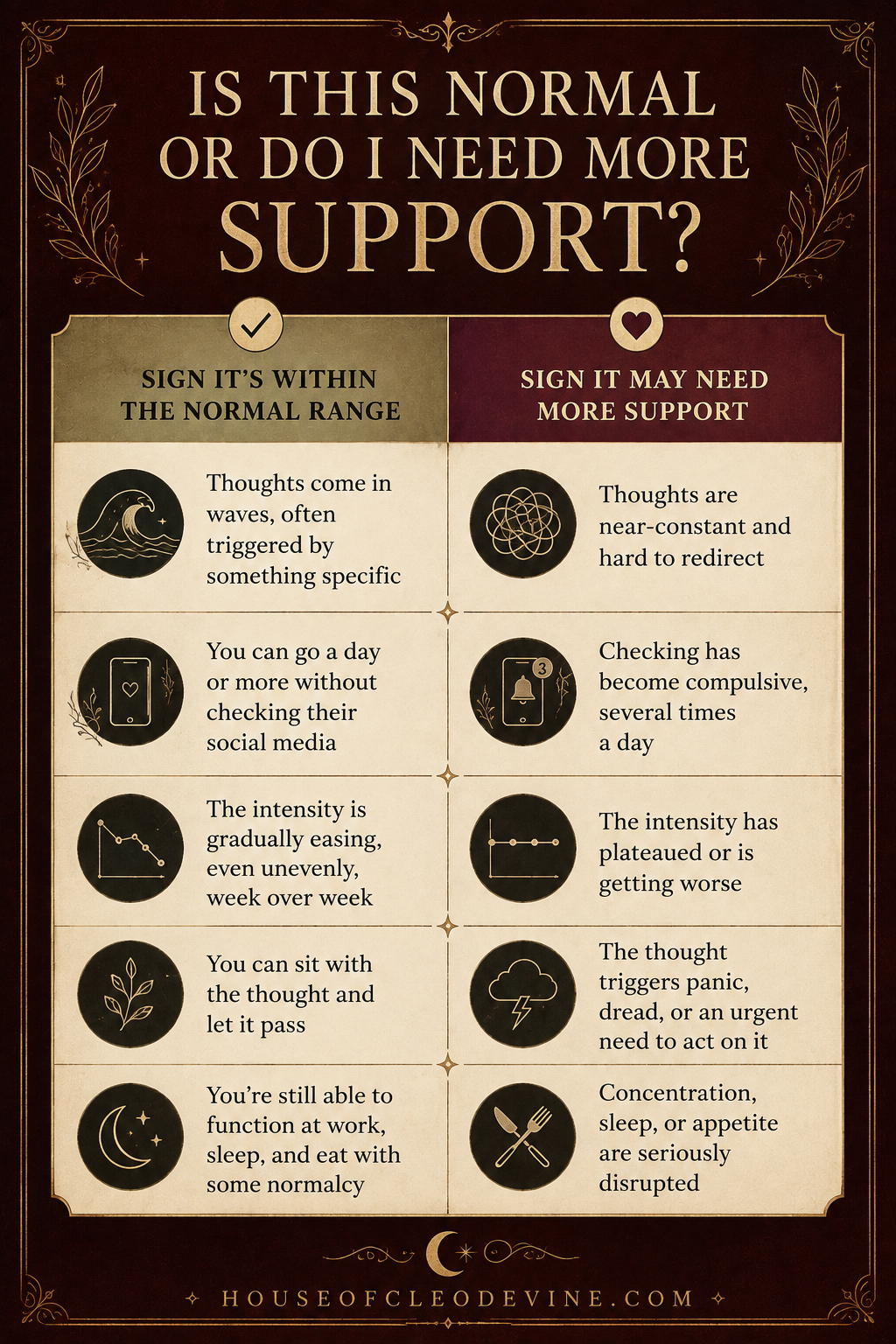
If more items in the right column feel true, it's worth talking to a therapist, particularly one familiar with attachment or obsessive-compulsive patterns. Persistent, distressing, hard-to-control thoughts are treatable, and there's no shame in needing more than time and ritual to move through them.
What Helps: Working With Both the Mind and the Energy
For the neurological piece: Limit the behaviors that feed the craving cycle, especially checking their social media, which functions much like a small hit of the same reward response. Give yourself something to physically redirect toward when a thought arrives — movement, a call to a friend, even just naming out loud what's happening in your body. And trust the timeline data: the pull does measurably lessen with distance, even when it doesn't feel like it will.
For the energetic piece, if it resonates with you: This is where deliberate release work — a cord-cutting ritual, an intentional practice of visualizing the connection loosening, or a guided release session — can offer something the neuroscience alone doesn't: a felt, embodied sense of closure. Many people find that combining both approaches, addressing the craving cycle practically while also doing intentional energetic release, moves them through this faster than either approach alone.
If you want to go deeper into the ritual side of this, How to Cut Energetic Cords and Heal Soul Ties After a Breakup walks through the practice itself. And if you're not sure whether what you're carrying is grief, a trauma bond, or a cord — because it's genuinely common to be dealing with a mix of the three — this piece can help you sort out which one fits.
Frequently Asked Questions
Is it normal to think about an ex every day, months later? Occasional daily thoughts, especially early on, are within the normal range, particularly for longer or more intense relationships. What matters more than frequency is trajectory — whether the intensity is gradually softening over time.
Does no contact actually help stop the thoughts? It can, though not because it erases the memory. Limiting contact removes the intermittent reward cues (a text, a like, a story view) that keep the craving cycle active, which is part of why no-contact periods are so consistently recommended in both psychological and spiritual approaches to breakup recovery.
Can thinking about someone constantly mean there's an energetic cord? Within the energetic framework, yes, that's often how a cord is described. It's worth holding that as one possible lens rather than the only explanation — the same experience is also fully explained by attachment neuroscience, and many people find both frameworks true at once.
How long does it typically take for the thoughts to fade? There's no fixed timeline, and it depends on the length and intensity of the relationship, but neuroimaging research on rejection found that attachment-related brain activity measurably decreases as more days pass since the breakup, even when contact and thinking patterns are accounted for.
When should I talk to a professional instead of just waiting it out? If the thoughts are compulsive rather than occasional — frequent checking, difficulty concentrating, disrupted sleep or appetite, or a sense that you can't control the pattern even when you want to — that's worth bringing to a therapist rather than managing alone.
Does cutting the cord make you forget them? No, and that's not really the goal. Cord-cutting work is about loosening the compulsive pull, not erasing the memory or the meaning the relationship held. Most people describe the shift as being able to think of the person without the thought hijacking the rest of their day.
The ache of not being able to stop thinking about someone is real, whether you're looking at it through a brain scan or through the language of energy. You don't have to choose one explanation over the other, and you don't have to white-knuckle your way through it either. Give your nervous system time, give the craving cycle less to feed on, and if it feels right, give the energetic piece of it some deliberate attention too.
If you're ready to work with the energetic side of this directly, the Cord Cutting Session is designed for exactly this kind of lingering, specific attachment.
Further Reading From House of Cleo Devine
How to Cut Energetic Cords and Heal Soul Ties After a Breakuphttps://www.houseofcleodevine.com/the-archive/why-you-still-feel-energetically-connected-after-a-breakupThe natural next step for readers ready to work with the energetic side of this ritually.
Grief, Trauma Bonding, or Energetic Cord? How to Tell What You're Actually Feelinghttps://www.houseofcleodevine.com/the-archive/grief-trauma-bond-or-energetic-cordHelps readers determine whether the obsessive thinking pattern described here is layered with grief or a trauma-bond pattern underneath it.
The Difference Between an Energy Cleanse and a Cord Cutting (And When You Need Each One)https://www.houseofcleodevine.com/the-archive/the-difference-between-an-energy-cleanse-and-a-cord-cutting-and-when-you-need-each-oneFor readers deciding which specific service matches what they're experiencing.
5 Signs You're Carrying Energy That Isn't Yours (And How to Clear It Safely)https://www.houseofcleodevine.com/the-archive/5-signs-youre-carrying-energy-that-isnt-yours-and-how-to-gently-clear-itRelevant for readers whose obsessive thinking is bleeding into general heaviness or fatigue.


















Reputable Sources
Fisher, H.E., Brown, L.L., Aron, A., Strong, G., & Mashek, D. — Reward, Addiction, and Emotion Regulation Systems Associated With Rejection in Love, Journal of Neurophysiologyhttps://journals.physiology.org/doi/full/10.1152/jn.00784.2009
Rutgers University — Study Finds Romantic Rejection Stimulates Areas of Brain Involved in Motivation, Reward and Addictionhttps://www.rutgers.edu/news/study-finds-romantic-rejection-stimulates-areas-brain-involved-motivation-reward-and-addiction
Stony Brook University News — Anguish of Romantic Rejection May Be Linked to Stimulation of Areas of Brain Related to Motivation, Reward and Addictionhttps://news.stonybrook.edu/newsroom/press-release/general/072110romanticrejection/
Helen Fisher, PhD — The Tyranny of Love: Love Addiction, An Anthropologist's Viewhttps://helenfisher.com/the-tyranny-of-love-love-addiction-an-anthropologists-view/
Psychology Today — Your Brain in Lovehttps://www.psychologytoday.com/us/blog/psych-unseen/201602/your-brain-in-love
Psychology Today — How to Stop Thinking About an Exhttps://www.psychologytoday.com/us/blog/the-mysteries-love/201610/how-stop-thinking-about-ex