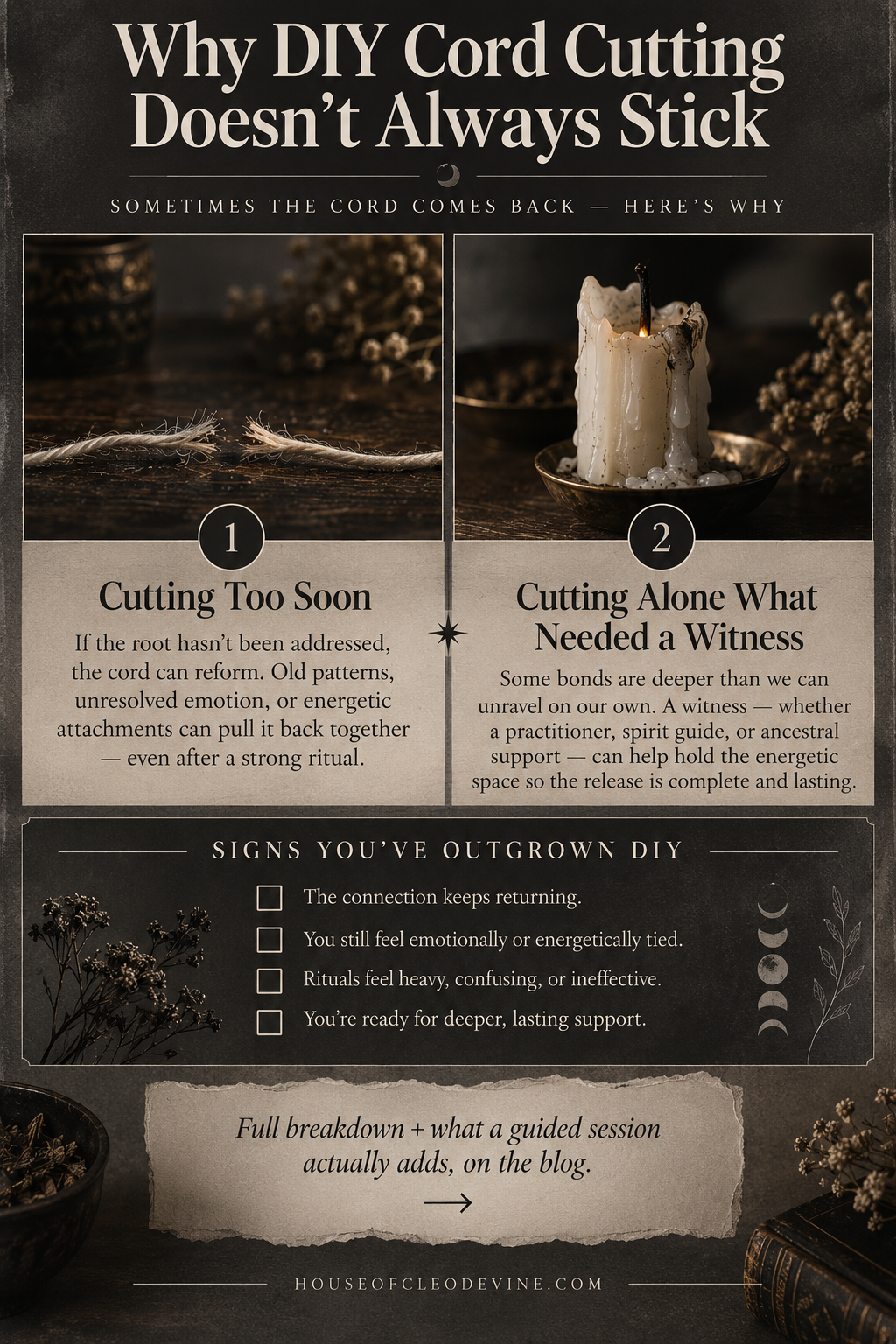
DIY Cord Cutting vs. a Guided Session: When a Candle and a Prayer Aren't Enough
You lit the candle. You said the words. Maybe you even felt something shift for a day or two. And then it came back, sometimes worse than before, like the cord didn't just fail to release but actually tightened its grip. If this is you, here's the honest answer: it's not that cord cutting doesn't work. It's that some cords are genuinely beyond what a solo candle and a few words can reach, and knowing the difference matters more than trying the same ritual a fourth time.
What DIY Cord Cutting Actually Does Well
Before getting into its limits, it's worth being fair to self-guided practice, because it genuinely does work for a real category of situations. Straightforward, relatively recent connections, ones without layered trauma, repeated betrayal, or years of entangled history, often respond well to a sincere, well-intentioned self-guided ritual. DIY cord work is also useful as maintenance between deeper sessions, keeping your energy clear day to day rather than only addressing major releases. If what you're releasing is genuinely light, self-guided work is often exactly the right tool, no more, no less than what the situation calls for.
The Two Real Reasons DIY Cord Cutting Often Doesn't Fully Work
When self-guided cord cutting doesn't hold, it's rarely because the practice itself is flawed. Licensed acupuncturist and Reiki Master Teacher Bronwyn Ayla, who has spent nearly three decades in this specific work, identifies two consistent reasons self-guided attempts fail, and both are worth sitting with honestly.
The first is cutting too soon, before the inner work is done. Cord cutting is a release, not a substitute for the emotional processing that has to happen first, grieving, understanding what happened, genuinely being ready to let go rather than performing readiness. A ritual performed on top of unresolved grief or ambivalence tends to address the symbolic layer without touching what's actually keeping the connection active.
The second is cutting alone something that genuinely needed a witness. Certain cords, ones tied to real trauma, deep betrayal, or relationships spanning years, carry a depth that solo work often can't fully reach. Having someone else hold the space while you do the release, someone trained to work directly within the energetic field rather than just observing from outside it, changes what the ritual is actually capable of doing.
Both of these are correctable. Neither means you did something wrong, only that the specific cord you're working with needed something DIY practice wasn't built to provide.
What a Guided Session Actually Adds
The difference isn't about the guided version having "more magic." It's about depth and precision. Where a self-guided ritual works at the surface of the energetic field, a trained practitioner works directly within it, with the tools and experience to reach layers that solo practice typically doesn't touch. This is particularly relevant for cords connected to abusive relationships, significant trauma, or patterns that have repeated across multiple relationships rather than being contained to one.
A guided session also brings something structurally different: a witness. Someone holding the space while you do the release, rather than you narrating your own intention into an empty room, changes the felt experience of the work for many people, and according to practitioners who do this work regularly, it changes the actual depth of what gets released, not just how supported the process feels.
Signs You've Outgrown DIY Work
A few patterns suggest it's genuinely time to move from self-guided practice to guided support, rather than trying the same ritual again:
You've done a self-guided release more than once for the same connection, with only temporary relief each time
The cord is tied to a relationship involving real trauma, betrayal, or abuse, not just an ordinary difficult ending
The pull came back more intensely after your attempt rather than gradually fading, similar to what some describe as the connection returning "with a vengeance"
You notice the same type of cord keeps forming in new relationships, suggesting a deeper, repeating pattern rather than one isolated connection
You're not fully certain you did the inner work first, and suspect you cut the cord hoping it would do that work for you
If two or more of these are true, that's usually a clear enough signal that the next attempt is better spent with guided support than repeating the same solo ritual.
What to Actually Expect From a Guided Session
It's worth setting honest expectations rather than promising instant transformation. A guided cord cutting session is typically not a single, magical fix that erases every trace of a connection in one sitting, particularly for deeply patterned or trauma-linked cords. Many practitioners note that healing takes real time, and that more than one session is sometimes necessary depending on how long and how deep the relationship ran. What a guided session does reliably offer is depth beyond what solo work reaches, a witnessed, held space for the release itself, and often direct feedback afterward, what came up, what shifted, what to expect as you continue healing.
DIY Isn't Wrong. It's a First Step, Not Always the Last One
If your self-guided attempt didn't fully hold, that's not failure, and it's not proof that cord work in general doesn't work for you. It's information. It tells you something real about the depth of what you're releasing, and it points toward the next right step rather than the same step repeated. Some cords are lighter than they feel from the inside. Some are genuinely heavier than a solo ritual was ever going to reach. Neither is a reflection of doing it "wrong."
A full Cord Cutting Ritual is built specifically for the connections that need this deeper, witnessed layer of release, work performed directly within your energetic field rather than guided from the outside. If you're also holding onto a family wound or a pattern beyond a single relationship, the Cut the Cord: Reclaim Your Power course pairs guided teaching with an included Reiki cord-cutting, return-to-sender clearing, and full chakra balancing session, giving you both the framework and the deeper release in one place.

Frequently Asked Questions
How do I know if my cord is "light" enough for DIY, or if I need guided support? A useful gauge: if you've genuinely done the emotional processing first and the connection is relatively recent or uncomplicated, DIY is often enough. If the relationship involved real trauma, spans years, or you've already tried solo work more than once without lasting relief, that's a strong signal to move to guided support.
Can I do DIY maintenance between guided sessions? Yes, and this is actually one of the better uses of self-guided practice, keeping your energy clear day to day while reserving deeper, less frequent work for a trained practitioner.
Is it bad that my first DIY attempt didn't work? No. It's common, and it's genuinely useful information about the depth of what you're dealing with rather than a sign you did anything incorrectly.
Why did the connection feel stronger after I tried to cut it myself? This can happen when a cord tied to real trauma or a long history is addressed only at the surface level; the underlying pattern remains fully active and can feel more noticeable once you've drawn conscious attention to it without fully releasing it.
Does a guided session guarantee the cord won't come back? No practitioner can honestly guarantee a permanent, one-time result, particularly for deeply patterned or trauma-linked connections. What a guided session offers is a meaningfully deeper release than solo work typically reaches, sometimes requiring more than one session depending on the connection's depth.
Is guided cord cutting a replacement for therapy? No, and it isn't meant to be. Guided energetic work can meaningfully complement therapy or other professional support, particularly for trauma-linked patterns, but it isn't a substitute for it.
If a candle and a few words haven't been enough, that's not a dead end. It's a clear signal about what this particular connection actually needs. Some cords ask for less than we think. Others ask for more, a witness, real depth, and someone trained to work within the field rather than around it.
If you recognize your situation in what's described above, the Cord Cutting Ritual is built for exactly this deeper layer of release.