

How to Break a Trauma Bond, Spiritually and Psychologically

If you're here, you probably already know the name for what's happening to you, and knowing the name hasn't made it any easier to leave. That's the cruelest part of a trauma bond: understanding the mechanism intellectually rarely loosens its grip on its own. Breaking one takes both psychological groundwork and, for many people, something more, a felt, embodied sense of release that pure insight doesn't reach. This is where both paths, the clinical and the spiritual, genuinely matter, and where treating either one as optional tends to leave people stuck.
Safety First, Before Anything Else
Before anything else in this piece: if there's any danger in your situation, physical, financial, or otherwise, safety planning comes before any of the emotional or spiritual work below. This can mean securing important documents, having emergency funds set aside, telling trusted people what's happening, and knowing where you'd go if you needed to leave quickly. The National Domestic Violence Hotline (1-800-799-7233) offers confidential support and safety planning regardless of whether you're certain what's happening qualifies as abuse. You don't need to have all the language sorted out to reach out.
What Actually Keeps a Trauma Bond in Place
A trauma bond forms through cycles of harsh treatment mixed with intermittent affection, and the unpredictability itself is what makes it so powerful. Because the good moments are inconsistent rather than guaranteed, the nervous system fixates on trying to earn them back, producing an attachment that can feel like love or deep loyalty even though it's built on a repeating, damaging pattern. This isn't a character flaw or a lack of willpower. It's a nervous system doing exactly what unpredictable reward systems do to any brain, which is part of why trying harder rarely works as a strategy on its own.
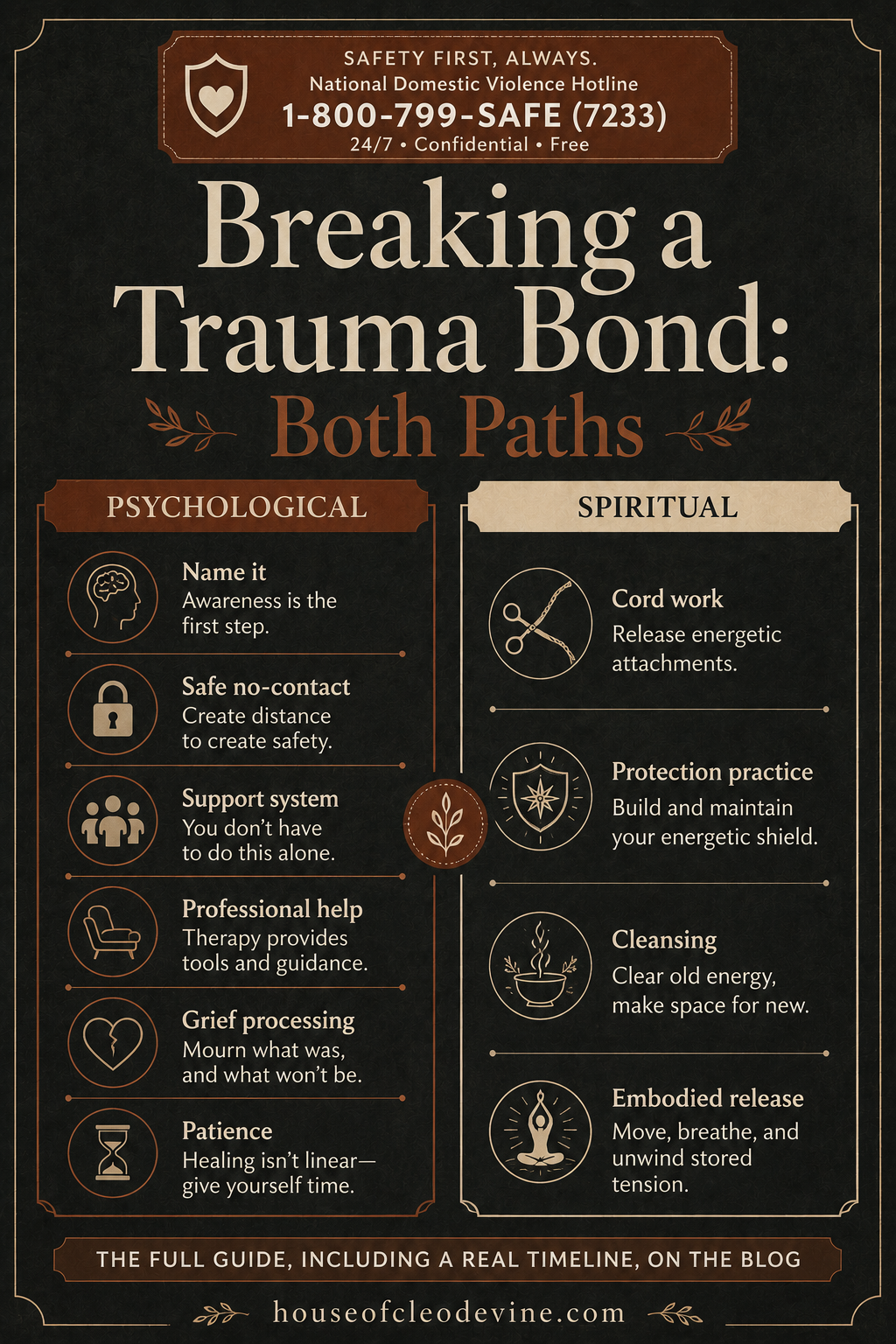
The Psychological Path
Name it accurately, and keep naming it. A trauma bond isn't love with some complications. It's a specific attachment pattern with a specific mechanism. Simply and repeatedly reminding yourself "this is a trauma bond, not a healthy relationship" does real work, even when it doesn't feel like enough by itself.
Go no-contact, with a safety plan around it, not instead of one.No-contact is consistently identified as one of the most effective single steps for breaking the cycle, because contact resets the reward loop each time. If there's any risk involved in cutting contact, build the safety plan first, ideally with support from a domestic violence advocate, before implementing it.
Build support before you'll feel ready for it. Isolation is often part of how a trauma bond took hold in the first place, so rebuilding connection, friends, family, a support group, a therapist, is not a nice-to-have. It's part of the actual mechanism of recovery, not just emotional comfort on the side.
Get support that works with the body, not just the mind. Clinicians increasingly describe trauma bonding as a nervous system problem rather than purely a thinking problem, which means insight and willpower alone often aren't enough. Therapies that work somatically, alongside cognitive approaches, tend to help the body register that the danger has actually passed, not just the mind.
Let the grief move through you instead of skipping it. One of the more overlooked reasons people relapse into contact is that they try to go no-contact without processing the very real grief underneath it, and the grief resurfaces later as an overwhelming urge to reach out. Feeling the longing, the anger, the confusion, without acting on it, is different from suppressing it, and it tends to make the urge to contact them pass rather than build.
Don't rush into rebuilding, especially not with someone new. It's common to seek a new relationship quickly to fill the space left behind, but doing this before your attachment system has had time to recalibrate can mean unconsciously recreating the same intensity you just left. Give the pattern time to settle before you trust your read of a new connection.
Expect a real timeline, not a quick fix. Healing from a trauma bond typically unfolds over weeks to months rather than days, and it isn't linear. Setbacks, an urge to reach out, a moment of doubt about whether it was really that bad, are a normal part of the process, not evidence that you're failing at it.
The Spiritual Path
Within contemporary energetic and folk-spiritual practice, a trauma bond is often understood to also carry an energetic dimension, sometimes described as a cord or an unhealthy tie, separate from but layered on top of the psychological attachment. This is a spiritual interpretation, not a clinical claim, and it's worth holding it as exactly that: a framework many people find genuinely useful alongside the clinical work, not instead of it.
Within this framework, spiritual practice can offer something the psychological work alone doesn't always reach: a felt, embodied sense of release, rather than only an intellectual understanding of what happened. This might include intentional cord-cutting or unbinding ritual, protection work meant to support your energetic boundaries while you rebuild them psychologically, and cleansing practices to address the general heaviness that often lingers after leaving an intense, harmful dynamic.
It's worth being direct about the limits here. Spiritual practice is not a substitute for physical safety planning, professional trauma support, or the psychological work above, particularly if there's any ongoing danger. What it can do is support the parts of healing that pure cognitive understanding tends to miss: the sense of still being tied to someone even after you fully, intellectually understand why you shouldn't be.
What Doesn't Work
Relying on willpower alone. Because a trauma bond operates through nervous system conditioning, trying to simply be more disciplined tends to fail in the same way willpower alone tends to fail with other addictive patterns.
Seeking closure from the person who caused the harm. Waiting for them to finally explain themselves, apologize sufficiently, or give you the ending that makes sense keeps the reward loop active. Closure that actually holds tends to come from within the recovery process, not from a conversation with them.
A single ritual with no psychological groundwork underneath it. Spiritual release work tends to be far more effective after some genuine emotional processing has happened, not as a way to skip that step entirely.
Trying to do it entirely alone. Isolation was often part of the original pattern, and recovery tends to require the opposite: real, consistent support from people or professionals who aren't part of the dynamic you're leaving.
Frequently Asked Questions
How long does it take to break a trauma bond? It varies significantly by person and by the intensity and length of the relationship, but it typically unfolds over weeks to months rather than days, and rarely in a straight line. Setbacks are common and don't mean the process has failed.
Is it possible to break a trauma bond without going no-contact? Full no-contact is consistently identified as one of the most effective single steps, but if that isn't immediately possible, for co-parenting situations or other unavoidable contact, low-contact with firm boundaries and strong outside support is a meaningful alternative starting point.
Can you have a trauma bond with someone who wasn't your romantic partner? Yes. Trauma bonds can form in family relationships, friendships, and other dynamics involving cycles of harm and intermittent affection, not only romantic ones.
Is spiritual work enough on its own to break a trauma bond? Spiritual practice can meaningfully support the felt sense of release, but it isn't a substitute for the psychological work, or for safety planning if there's any danger involved. Most people find combining both more effective than relying on either alone.
Why do I still miss them even though I know they hurt me? This is one of the clearest markers of a trauma bond specifically, rather than ordinary heartbreak. The intensity of missing someone measures the strength of the intermittent-reinforcement cycle you were in, not how good the relationship actually was.
What if I relapse and reach out again? This is common, not a sign of failure. Recovery from a trauma bond is rarely linear, and a relapse in contact is an opportunity to recommit to your safety plan and support system, not evidence that the whole effort was wasted.
Breaking a trauma bond is genuinely one of the harder things a person can do, precisely because it asks you to work against a nervous system pattern that feels, from the inside, exactly like love. Give yourself real support, real time, and if it resonates with you, both the psychological and the spiritual paths at once. You don't have to choose only one.
If you're ready to address the energetic layer of this alongside your other support, the Cord Cutting Session is built for exactly this kind of deep, patterned attachment. And if you're not yet certain whether what you're carrying is a trauma bond, grief, or an energetic cord, Grief, Trauma Bonding, or Energetic Cord? can help you get clear before you choose your next step. If you are in immediate danger, please reach out to the National Domestic Violence Hotline at 1-800-799-7233.
Further Reading From House of Cleo Devine
Grief, Trauma Bonding, or Energetic Cord? How to Tell What You're Actually FeelingEssential for readers who aren't yet sure whether what they're experiencing is a trauma bond specifically, versus grief or an energetic cord without the abuse pattern.
Why You Attract Emotionally Unavailable People (And How to Spiritually Break the Cycle)Directly relevant for readers whose trauma bond is part of a repeating relationship pattern, not a single isolated relationship.
9 Signs It's Time to Cut an Energetic CordFor readers ready to address the energetic layer of their trauma bond once the psychological groundwork is underway.
Can Someone Feel When You Cut an Energetic Cord?Relevant for readers processing the specific fear or hope that their former partner will somehow sense the release.


















Reputable Sources
Cleveland Clinic — Trauma Bonding
The Attachment Project — How to Break a Trauma Bond
Psychology Today — How to Break Free From a Trauma Bond
Psychology Today — 5 Signs of Trauma-Bonding
ChoosingTherapy.com — How to Break a Trauma Bond: 13 Steps From a Therapist
National Domestic Violence Hotline — 1-800-799-7233