

Soul Ties vs. Energetic Cords: What's the Difference?

You've probably heard both terms used for the same feeling: that sense of still being tied to someone, body and mind, long after the relationship itself has ended. Here's the direct answer: soul ties and energetic cords describe a nearly identical felt experience, but they come from two different spiritual traditions, use different language for how the bond forms, and are released through different practices. Neither is "more correct" than the other. What matters is understanding where each framework comes from, so you can work with the one that actually fits your own spiritual language, or understand why HCD sometimes uses both.
The Short Answer: Same Feeling, Different Framework
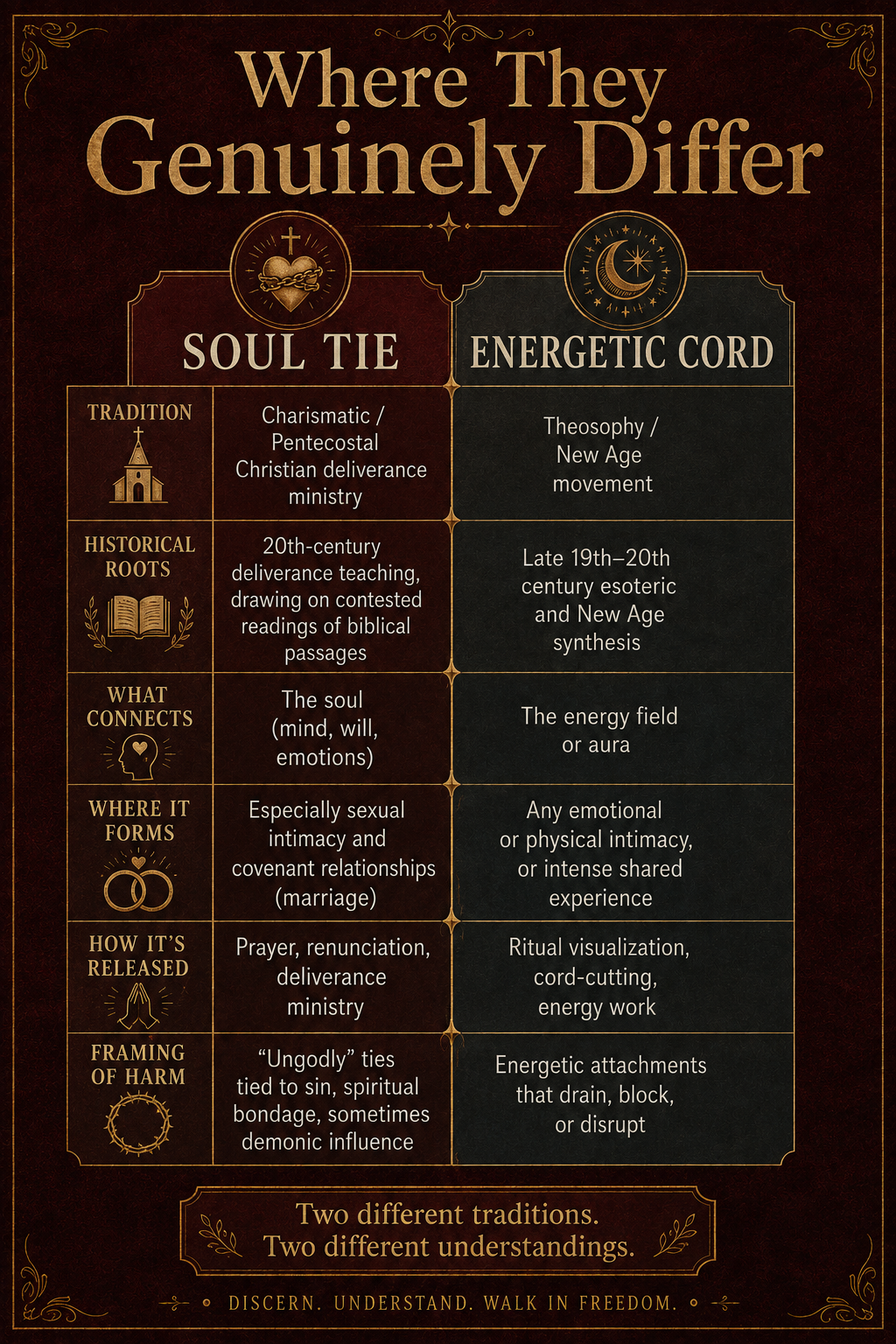
A soul tie is a term most associated with charismatic and Pentecostal Christian deliverance ministry, describing a spiritual bond between two people's souls, formed especially through sexual intimacy, deep emotional closeness, or covenant relationships like marriage. An energetic cord is a term rooted in Theosophy and the broader New Age movement, describing an attachment between two people's energy fields or auras, formed through emotional or physical intimacy of any kind. Both describe the same underlying human experience — feeling tethered to someone you're no longer with — but they emerged from entirely separate spiritual lineages, and it's worth being honest about that rather than blending them into one vague catch-all, which is what most articles on this topic do.
What Is a Soul Tie?
The phrase "soul tie" doesn't appear anywhere in the Bible. It's a term that developed within charismatic and Pentecostal deliverance ministry teaching, built on particular interpretations of a small handful of verses — most often 1 Samuel 18:1, which describes David and Jonathan's friendship using language that some translations render as their souls being "knit" together. Deliverance teachers extend this and similar passages, such as 1 Corinthians 6:16 on sexual union, to argue that emotional and physical intimacy create a genuine spiritual bond between two people's souls, one that can persist and cause spiritual difficulty even after a relationship ends.
It's worth naming the genuine disagreement here rather than smoothing it over: many Christians, including some conservative biblical scholars, argue that soul ties are not a biblical concept at all, and that the supporting verses are being read well beyond their original meaning. Others within charismatic and deliverance-focused Christian communities hold soul ties as a real and important part of spiritual life, distinguishing between "godly" soul ties (marriage, close friendship, healthy family bonds) and "ungodly" ones formed through sexual sin or manipulative relationships, the latter requiring prayer and deliverance to break.
Within this framework, an ungodly soul tie is typically understood to be broken through prayer, renunciation, and deliverance — verbally and spiritually declaring the tie severed, often invoking scripture and asking for release from any residual influence.
What Is an Energetic Cord?
An energetic cord, by contrast, comes out of a different spiritual lineage entirely. The language of energy fields, auras, and cords connecting people is largely a development of Theosophy, the esoteric movement founded in the late 1800s, later absorbed and popularized more widely by the New Age movement beginning in the 1970s. Within this framework, a cord is understood as a genuine energetic attachment between two people's auras or energy fields, formed through emotional exposure, physical intimacy, or intense shared experience of any kind, not specifically sexual or covenantal.
Energetic cords are typically described as running between chakras rather than souls, can be positive or negative depending on the nature of the relationship, and are generally released through ritual visualization, symbolic cord-cutting practices, or energy work like Reiki, rather than through prayer or scriptural renunciation.
Where They Overlap
The overlap is significant, which is exactly why the two terms get used interchangeably so often, including sometimes on this very site. Both frameworks describe:
A bond that forms through intimacy, especially sexual intimacy
A connection that persists after the relationship or contact ends
The possibility of a "positive" or "healthy" version of the bond, not just a harmful one
A felt, sometimes physical sense of the connection, rather than a purely intellectual one
A specific practice (deliverance prayer or cord cutting) designed to intentionally sever the connection
If you've felt something that fits this description, both frameworks are pointing at the same real experience. The difference is in the vocabulary and the ritual, not necessarily in what you're feeling.
Which Framework Fits You?
Neither framework requires the other to be wrong. Many people move between both, using whichever language feels most true to their own spiritual background, and there's nothing inconsistent about that. A few things worth considering:
If you come from a Christian background, or the idea of prayer and renunciation feels more resonant and less foreign than energy work, the soul tie framework, and specifically deliverance-style prayer, may be the more natural fit. This doesn't require you to accept every claim of every deliverance teacher; it simply means working within a vocabulary your own belief system already holds.
If you relate more to energy, chakras, or a felt sense of your aura, the energetic cord framework and its associated release practices, like a cord-cutting ritual, will likely feel more intuitive.
If you're not sure, or you draw from both, that's genuinely common, and worth honoring rather than forcing yourself into one camp. What matters far more than which vocabulary you use is whether the release practice you choose actually helps you feel lighter, clearer, and more like yourself.
Frequently Asked Questions
Is a soul tie the same thing as a trauma bond? No, though they can coexist. A trauma bond is a clinical psychological term describing attachment formed through cycles of abuse and intermittent affection. A soul tie is a spiritual framework describing a bond formed through intimacy, which can exist in both healthy and unhealthy relationships.
Can you have a soul tie or energetic cord with a friend or family member, not just a romantic partner? Yes, within both frameworks. Soul tie teaching specifically includes covenant relationships like family and close friendship, not only romantic or sexual bonds. The energetic cord framework is even broader, extending to any relationship involving emotional intensity.
Do I need to choose one framework and stick with it? No. Many people use both terms depending on context, or gravitate toward whichever feels more natural without needing to resolve the theological or metaphysical question of which is "more real."
Is it wrong to combine deliverance prayer with energy work like cord cutting? This is a matter of personal spiritual conviction, and reasonable people land in different places. Some traditions hold these practices as incompatible; others integrate them freely. If you have a specific faith community, it's worth checking what feels aligned with your own convictions rather than assuming either approach.
Which one is more effective for actually feeling free of the connection? Neither framework has been established as more effective through independent evidence; both are spiritual practices rather than clinically studied interventions. What tends to matter most, across both approaches, is genuine intention, sufficient emotional processing beforehand, and a practice that feels meaningful and resonant to the person doing it.
Are soul ties always about sex? No, though sexual intimacy is the most commonly cited way they form within deliverance teaching. Soul ties are also described forming through covenant relationships like marriage, close friendship, and family bonds.
Whatever language fits you, the underlying experience — still feeling tethered to someone the relationship has otherwise ended with — deserves to be taken seriously rather than dismissed. If the felt pull is real for you, both traditions offer a path toward actually releasing it, not just naming it.
If the energetic-cord framework resonates more, How to Cut Energetic Cords and Heal Soul Ties After a Breakup and the Cord Cutting Session walk through that path directly. And if you're still sorting out whether what you're feeling is a spiritual attachment at all, versus grief or a trauma-bond pattern, this piece can help you get clear before you choose a release practice.
Further Reading From House of Cleo Devine
How to Cut Energetic Cords and Heal Soul Ties After a Breakuphttps://www.houseofcleodevine.com/the-archive/why-you-still-feel-energetically-connected-after-a-breakupThe practical next step for readers who relate more to the energetic-cord framework specifically.
Grief, Trauma Bonding, or Energetic Cord? How to Tell What You're Actually Feelinghttps://www.houseofcleodevine.com/the-archive/grief-trauma-bond-or-energetic-cordHelps readers determine whether what they're feeling is a spiritual attachment at all, or something that needs a different kind of support first.
11 Signs You Have an Energetic Cord With Someonehttps://www.houseofcleodevine.com/the-archive/signs-energetic-cordA deeper dive into the specific felt signs of an energetic cord, for readers who've landed on that framework.
The Difference Between an Energy Cleanse and a Cord Cutting (And When You Need Each One)https://www.houseofcleodevine.com/the-archive/the-difference-between-an-energy-cleanse-and-a-cord-cutting-and-when-you-need-each-oneFor readers ready to choose a specific energetic release practice.



Reputable Sources
Christianity.com — What Should Christians Know about Soul Ties? https://www.christianity.com/wiki/christian-life/what-should-christians-know-about-soul-ties.html
GotQuestions.org — What Does the Bible Say About Soul Ties? https://www.gotquestions.org/soul-ties.htm
Mike Signorelli Ministries — What Are Soul Ties and How Do I Get Free? https://mikesignorelli.com/what-are-soul-ties-and-how-do-i-get-free/
Encyclopaedia Britannica — Theosophy: Definition, Beliefs, History, & Facts https://www.britannica.com/topic/theosophy
MIT Press Reader — The Long History of the Human Aura https://thereader.mitpress.mit.edu/the-long-history-of-the-human-aura/
Wikipedia — Deliverance Ministry (for general historical/denominational framing only) https://en.wikipedia.org/wiki/Deliverance_ministry