

Is It Grief, Trauma Bonding, or an Energetic Cord? A Real Framework for Telling Them Apart

You already know something is still tangled. Weeks, maybe months, out from the breakup, and you're still checking their name against your chest like a bruise you can't stop pressing. Someone told you it's grief. Someone else said trauma bond. You read a post at 1 a.m. that said energetic cord, and that one, for whatever reason, was the one that made you sit up straight.
Here's the honest answer: it can be any of the three. It can be two of them at once. Grief, trauma bonding, and an energetic cord are not the same experience wearing different names, even though they can feel eerily similar from the inside — the same 2 a.m. ache, the same involuntary reach for the phone. They come from different places, they ask for different kinds of care, and mistaking one for another usually means you end up doing the wrong kind of healing work for what's actually happening in you. This is where we sort out which is which, and what to do once you know.
What's the Difference Between Grief, Trauma Bonding, and an Energetic Cord?
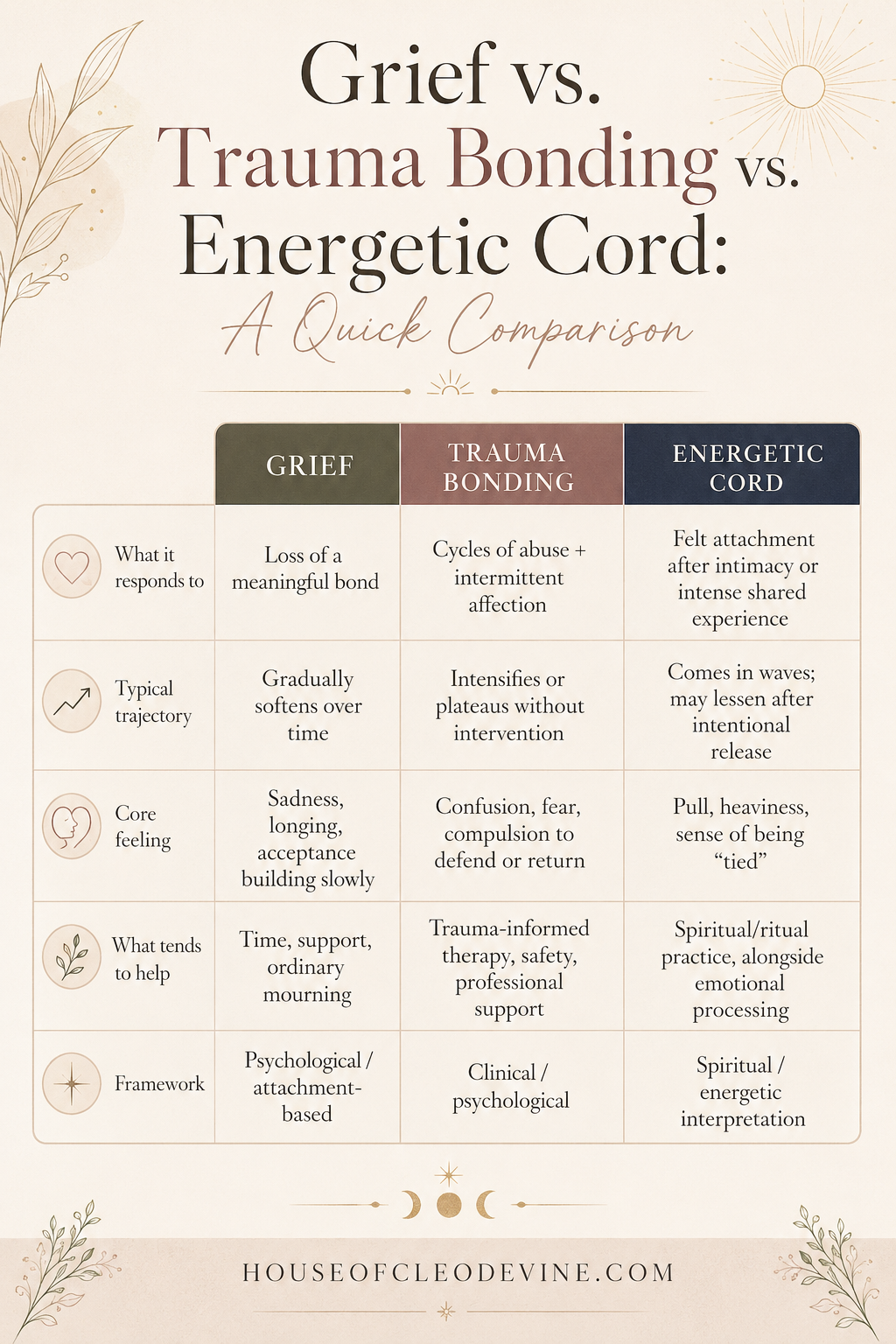
Grief is the natural response to losing something that mattered, whether or not the relationship was healthy. Trauma bonding is a specific attachment pattern that forms under cycles of abuse and intermittent affection. An energetic cord, within contemporary spiritual practice, describes a felt connection that lingers between two people's energy fields after intimacy or intense shared experience.
They're related but distinct. Grief can exist with or without trauma bonding. Trauma bonding almost always comes with grief. And a felt "cord" — that sense of an invisible thread still pulling — is something people commonly describe during either grief or trauma bonding, which is exactly why the three get so tangled up in language.
Signs It's Ordinary Grief
Grief, even after a bad or complicated relationship, is not a sign that something is spiritually or psychologically wrong. Psychologist John Bowlby's research on attachment established that grief is the expected response any time a significant emotional bond is broken — not only through death, but through the end of any relationship that mattered, as grief can be conceptualized as an extension of the attachment system, a response to a loss event causing separation distress that isn't limited to death. Later attachment researchers extended this further, showing that people commonly try to find new sources of security to replace what a relationship provided, and that this reorganizing process — not detachment, not "getting over it" on a schedule — is what healthy grieving actually looks like, as people who lose a close relationship partner often attempt to find other attachment figures who can restore a sense of security.
Ordinary grief usually looks like:
Waves of sadness that come and go, rather than a constant low hum of fear or hypervigilance
Missing the good parts of the relationship without needing to justify or excuse anything bad that happened in it
Gradual softening over weeks and months, even if it's not linear
The ability to acknowledge, clearly, why the relationship ended
Physical symptoms — appetite changes, disrupted sleep, low energy — that slowly ease rather than intensify
Signs It Might Be Trauma Bonding
Trauma bonding is a specific clinical term, not a synonym for "really missing someone." It was first named by psychologist Patrick Carnes to describe an attachment that forms specifically through cycles of abuse mixed with intermittent affection. According to the framework, a trauma bond typically develops when a person perceives a real threat of danger from someone, experiences harsh treatment mixed with small periods of kindness, and is isolated from other people and outside perspectives. The unpredictability is the mechanism: because the good moments are inconsistent rather than guaranteed, the nervous system fixates on trying to earn them back, and this attachment often feels like love or deep loyalty even though it's built on a repeating, damaging pattern.
This is different from missing someone who simply wasn't right for you. Trauma bonding tends to show up as:
Defending or minimizing behavior from your ex that friends and family were concerned about
A push-pull history — cycles of intense closeness followed by devaluation, confusion, or withdrawal
Feeling like leaving is impossible even when you can clearly list the reasons you should
Anxiety that spikes rather than settles over time, especially around contact or no-contact
A sense that no one else could understand you the way they did
Signs It Might Be an Energetic Cord
Within contemporary energetic and folk-spiritual practice, an energetic cord describes a felt attachment that persists between two people after physical intimacy, deep emotional exposure, or shared trauma — independent of whether the relationship itself was healthy. This is a spiritual interpretation, not a clinically established phenomenon, and it's worth holding it as exactly that: a framework some people find genuinely useful for naming a felt experience that talk therapy alone doesn't always resolve.
Within that framework, people often describe:
A pull toward checking on someone, texting, or looking at their social media that doesn't feel fully like a choice
Sudden shifts in mood — sadness, unease, longing — with no clear trigger, especially around times you'd expect to think of them (anniversaries, shared songs, mutual friends)
A sense of "still being tied" even after full logical acceptance that the relationship is over
Physical heaviness or fatigue that eases somewhat after intentional release work, like a cord-cutting ritual or spiritual cleanse
The feeling returning in waves rather than resolving in one clean break, particularly if contact resumes
It's important to be honest here: many of these same sensations are also fully explained by grief and trauma-bonding psychology. Practitioners who work with energetic frameworks generally hold both things as true at once — that the nervous system is doing exactly what attachment research says it does, and that ritual, symbolic release work can still meaningfully support a person moving through it.
Grief vs. Trauma Bonding vs. Energetic Cord: A Quick Comparison
Why These Three Get Confused With Each Other
Language is part of the problem. "Energetic cord" has become a catch-all term online for any lingering attachment, which means it now gets used to describe straightforward grief, genuine trauma bonding, and everything in between. Meanwhile, clinical language like "trauma bond" has drifted into casual use to mean almost any intense connection, which the term was never meant to describe. Common misunderstandings around this term have become widespread — people often use it to mean simply connecting over shared struggles, which is not what trauma bonding actually means.
The other reason these overlap so much: they aren't mutually exclusive. You can be grieving a relationship that was also, in part, a trauma bond. You can describe that grief using cord language because it's the vocabulary that best captures the felt, physical quality of the pull. None of that makes the feeling less real. It just means the label matters less than paying attention to the pattern underneath it.
What to Do, Depending on What You're Feeling
If it's grief: Let it move through you without rushing it. Ordinary grief responds well to time, ritual closure (a letter you don't send, a small release ceremony, a candle burned with intention), and staying connected to supportive people rather than isolating.
If it's trauma bonding: This is the one that most needs outside support rather than solo spiritual work. A trauma-informed therapist can help you understand the cycle you were in without judgment. If there was any element of danger or coercion in the relationship, the National Domestic Violence Hotline (1-800-799-7233) offers confidential support regardless of whether you identify what happened as "abuse."
If it's an energetic cord — or grief and a cord together: This is where spiritual practice can genuinely support what you're already working through emotionally. A Cord Cutting Session is designed for exactly this kind of lingering attachment, and if you're also carrying general heaviness that doesn't feel tied to one specific person, our Spiritual Debris Cleanse clears residue more broadly.
Most people who write to me are living in more than one of these categories at once. That's not confusion on your part. That's an accurate read of something that genuinely is layered.
Frequently Asked Questions
Can you have an energetic cord without trauma bonding? Yes. Within the energetic framework, cords can form from any relationship involving intimacy or deep emotional exposure, healthy or not. A cord is about the intensity and closeness of the connection, not about whether harm occurred.
Is it possible to be trauma bonded and not realize it? Yes, and it's common. One of the defining features of trauma bonding is that it distorts your read of the relationship while you're in it, since the person experiencing it may develop sympathy for the person who's abusing them, reinforced by cycles of abuse followed by remorse. Outside perspective from a therapist or trusted friend often reveals patterns you couldn't see from inside.
How long does normal breakup grief usually last? There's no fixed timeline, and attachment researchers caution against expecting a clean, linear process. What matters more than duration is direction — whether the intensity is gradually easing over time, even unevenly, versus staying flat or worsening.
Does cord cutting work if the real issue is trauma bonding? Cord-cutting ritual can be a meaningful part of emotional release, but it isn't a substitute for trauma-informed therapy if the underlying pattern is a trauma bond. Many people use both: professional support for the psychological pattern, and ritual work for the felt, energetic experience of release.
Why do I still feel connected even though I know the relationship was bad for me? This is one of the clearest signs of trauma bonding rather than simple missing-them grief — the intensity of a felt connection doesn't measure how good a relationship was, it measures how strong the intermittent-reinforcement cycle was.
Is it normal to think about my ex years later? Occasional thoughts, especially triggered by memory cues, are normal and don't necessarily indicate an unresolved cord or bond. What's worth paying attention to is whether those thoughts are occasional and gentle, or frequent, distressing, and disruptive to your present life.
If you take one thing from this: you don't need the exact right label to start healing. But knowing whether you're grieving, healing from a trauma bond, or carrying a cord — or some mixture of the three — changes what kind of care actually helps. Give yourself the version of support that matches what's really happening underneath the ache, not just the version that's easiest to name at 2 a.m.
If a cord feels like the piece that's still active for you, the Cord Cutting Session is a natural next step. If you want to go deeper into the difference between everyday energetic maintenance and a full cord release, Energy Cleanse vs. Cord Cutting walks through exactly when each one is called for.
Further Reading From House of Cleo Devine
How to Cut Energetic Cords and Heal Soul Ties After a Breakuphttps://www.houseofcleodevine.com/the-archive/why-you-still-feel-energetically-connected-after-a-breakupGoes deeper into the mechanics and folk-spiritual framing of cord formation for readers who've identified their experience as primarily energetic.
The Difference Between an Energy Cleanse and a Cord Cutting (And When You Need Each One)https://www.houseofcleodevine.com/the-archive/the-difference-between-an-energy-cleanse-and-a-cord-cutting-and-when-you-need-each-oneHelps readers who've identified a cord decide which specific service actually fits what they're carrying.
5 Signs You're Carrying Energy That Isn't Yours (And How to Clear It Safely)https://www.houseofcleodevine.com/the-archive/5-signs-youre-carrying-energy-that-isnt-yours-and-how-to-gently-clear-itFor readers whose heaviness doesn't feel tied to one specific person or relationship.
Why You Keep Attracting Emotionally Unavailable People (And How to Shift the Pattern Spiritually, Not Just Mentally)https://www.houseofcleodevine.com/the-archive/why-you-keep-attracting-emotionally-unavailable-people-and-how-to-shift-the-pattern-spiritually-not-just-mentallyNatural next read for anyone recognizing a repeating trauma-bond pattern across multiple relationships.





















Reputable Sources
Psychology Today — Understanding Loss: Grief and Attachment Theory https://www.psychologytoday.com/us/blog/navigating-the-serpentine-path/202210/understanding-loss-grief-and-attachment-theory
Cambridge Core, BJPsych Advances — Bowlby's Trilogy https://www.cambridge.org/core/journals/bjpsych-advances/article/bowlbys-trilogy/6B3BE749EE3A30C5C9D613AB5F766FAD
ScienceDirect — An Attachment Perspective on Loss and Grief https://www.sciencedirect.com/science/article/abs/pii/S2352250X2100227X
Cleveland Clinic — Trauma Bonding https://health.clevelandclinic.org/trauma-bonding
Psychology Today — Trauma Bonding (Basics) https://www.psychologytoday.com/us/basics/trauma-bonding
HelpGuide.org — Understanding Trauma Bonding https://www.helpguide.org/mental-health/ptsd-trauma/trauma-bonding
AOL/Women's Health via Rachel Proujansky, PsyD — Everything You Think You Know About Trauma Bonding Is Wrong https://www.aol.com/lifestyle/everything-think-know-trauma-bonding-120000500.html