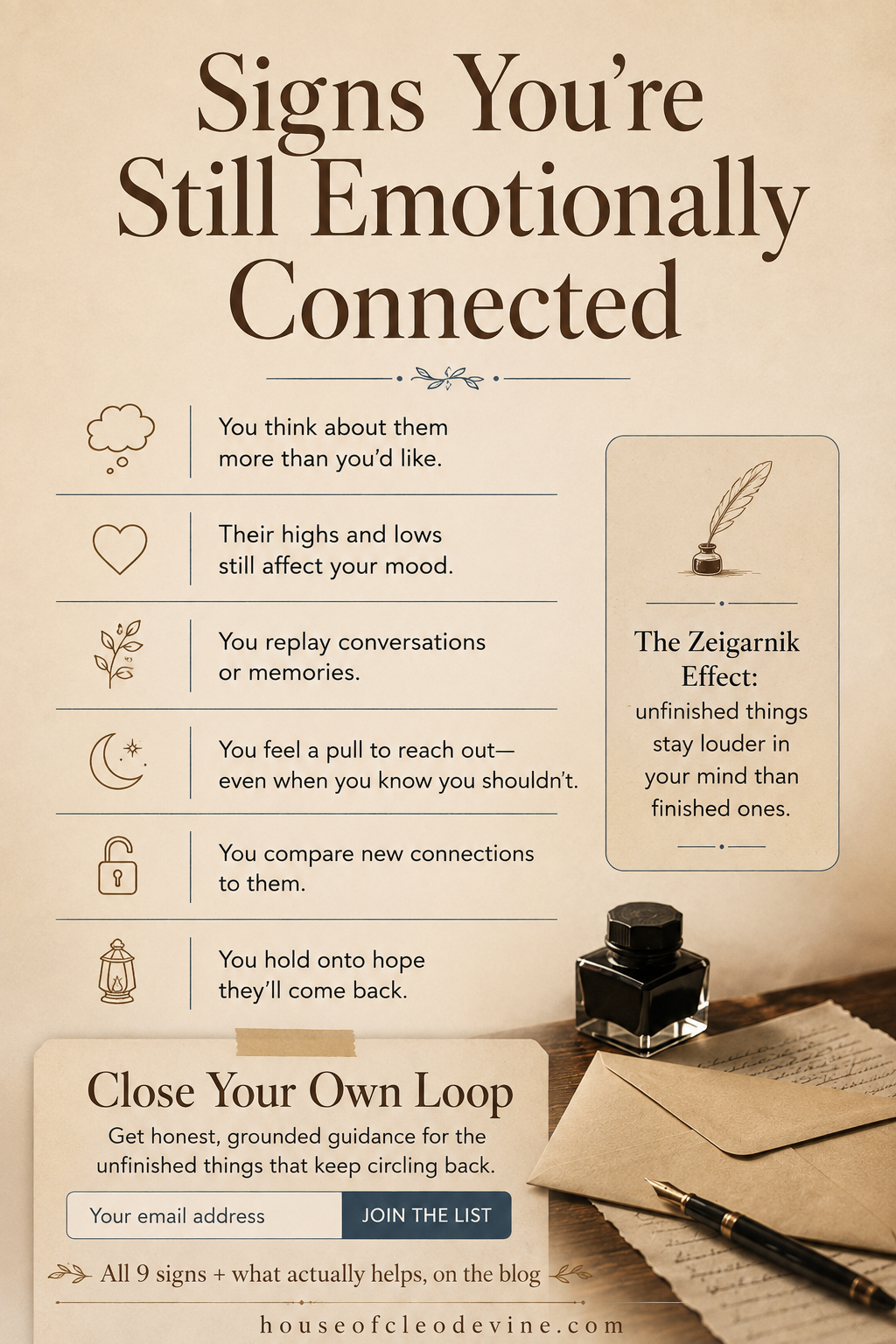
What Are They Thinking About Me? 9 Signs You're Still Emotionally Connected

Here's the honest, slightly uncomfortable truth before we go any further: there's no reliable way to know what's actually happening in someone else's head. What you can actually examine, with real clarity, is your own mind, and that's usually the more useful question anyway. The nine signs below aren't about reading their thoughts. They're about recognizing your own ongoing emotional connection, which turns out to explain most of what people are really asking when they type this question into Google at 1 a.m.
The Question Behind the Question
Most articles on this topic promise to reveal signs that someone else is thinking about you, twitching eyes, sudden warmth, mysterious pulls. It's worth being direct: there's no established evidence that another person's private thoughts can produce a physical sensation in your body from a distance, however real that sensation feels to you in the moment. What's genuinely knowable, and genuinely useful, is your own side of the connection. If you're here because you keep wondering whether they're thinking about you, the frequency of that very wondering is itself a real, measurable sign, just pointing in a different direction than most people expect. It's a sign about you, not a confirmed fact about them.
9 Signs You're Still Emotionally Connected
1. Their name still produces a felt reaction. A small jolt, a held breath, a flicker of something when it comes up in conversation or crosses your feed. This kind of reaction doesn't fade on command; it fades with time and, often, with resolution.
2. You compare new people or experiences to them automatically. Not necessarily wanting them back, but measuring new things against the shape they left behind. This comparison usually isn't a conscious choice; it just happens.
3. An unfinished conversation loops in your mind. Something that was never fully said, resolved, or explained keeps resurfacing, sometimes for months or years after everything else about the relationship has settled. This one has a real psychological name, and it's worth understanding on its own below.
4. You check for their presence without quite meaning to. A glance at their social media, a scan of a room for their face, a pause when a mutual friend mentions their name. The checking itself, more than what you find, is the sign worth noticing.
5. Certain days, songs, or places still pull you back. An anniversary, a specific song, a particular street, still land differently than ordinary days. This kind of anchored association is a normal feature of memory and doesn't require anything mystical to explain, though it often feels that way.
6. You rehearse conversations with them that never happen. Imagined arguments, imagined apologies, imagined catching up, playing out in your head with no actual audience. This is common and doesn't mean you're stuck; it usually means something wasn't said that you still feel needs saying, even if only to yourself.
7. You feel a pull to reach out, even when you know you shouldn't. The urge itself, regardless of whether you act on it, is a reliable marker of ongoing emotional investment.
8. Their opinion of you still carries unusual weight. Wondering what they'd think of a decision, an outfit, a life update, long after their opinion should logically matter less than it does, is a clear sign the connection hasn't fully settled.
9. You keep wondering if they're thinking about you. This is the reflexive sign, and it's the most reliable one on this list. The question itself is evidence of your own continued emotional investment, independent of anything happening on their end. Wanting to know what's in someone else's head is, itself, a form of still being connected to them.
Why Unresolved Connections Are So Hard to Stop Thinking About
Sign three deserves its own explanation, because it has a genuinely well-documented psychological basis that most spiritual content on this topic skips entirely. In the 1920s, Soviet psychologist Bluma Zeigarnik observed that waiters could recall the details of unpaid orders far more accurately than orders that had already been settled and paid. She identified what's now called the Zeigarnik effect: unfinished or interrupted matters stay far more mentally active and easily recalled than resolved ones. Your mind treats an open question the same way a waiter's mind treats an unpaid check, it keeps the details close until the matter closes.
This applies directly to relationships that ended without a clear resolution, a conversation that never happened, a goodbye that got cut short, a question you never got to ask. The lack of closure isn't just emotionally unsatisfying; it's cognitively active in a specific, documented way. Researchers Masicampo and Baumeister found in 2011 that simply making a concrete plan for an unfinished matter, deciding what you would say if you could, writing the letter you'll never send, reduces the intrusive quality of these thoughts nearly as effectively as actually finishing the task. The mind doesn't necessarily need real closure from the other person; it often just needs to register that the loop has been addressed in some form.















What About the "Sixth Sense" Feeling?
A lot of content on this topic leans on claims about mirror neurons, synced brainwaves, or energetic transmission to explain why a sudden feeling might mean someone else is thinking of you at that exact moment. It's worth being honest here: mirror neurons and emotional attunement are real areas of neuroscience, but they explain empathy and connection between people who are present with each other, not telepathic transmission across distance. No established research supports the claim that another person's private thoughts can directly cause a sensation in your body from far away. That doesn't make the felt experience meaningless. Within a spiritual framework, some people understand these sudden feelings as a genuine energetic signal; others understand them as the mind's own associative machinery firing in response to an internal or external cue. Both can be held as real experiences worth taking seriously, without needing to settle which explanation is correct.
What to Do With This Information
If several of these signs are resonating, the most useful next step usually isn't more waiting or watching for confirmation from their side. Borrowing directly from the Zeigarnik research above, giving the unresolved matter a concrete outlet, writing the unsent letter, journaling what you'd actually say, or deciding clearly whether reaching out is something you genuinely want to do, tends to quiet the loop more effectively than continuing to wonder passively.
If You Want a Clearer Read
Since their actual thoughts aren't something psychology, or anyone else, can confirm from the outside, some people find it genuinely useful to seek a different kind of perspective rather than continuing to guess alone. A What Are They Thinking? Tarot Reading offers exactly that: not a scientific claim, but a spiritual practice some people find brings clarity or at least a different angle to sit with, especially when the wondering itself has become the hardest part.
Frequently Asked Questions
Can two people really think about each other at the same time without any contact? There's no established scientific evidence for this happening as a direct transmission between minds. It's entirely possible for both people in a past connection to be independently thinking about each other, especially around shared anniversaries or triggers, without any signal passing between them.
Why do I think about my ex more than people I dated for longer? This often connects directly to the Zeigarnik effect: how a relationship ended, resolved cleanly or left open, tends to predict how persistently it stays mentally active more than how long it lasted or how deep it was.
Does writing an unsent letter actually help, or is it just a coping mechanism? Research specifically on making concrete plans for unfinished matters found it meaningfully reduces intrusive thoughts, nearly as effectively as actual resolution. An unsent letter functions similarly: it gives the mind a sense that the loop has been addressed.
Is it unhealthy to still think about someone from the past? Occasional thoughts, especially tied to real memories or unresolved moments, are a normal part of how memory and attachment work. It becomes worth attention if the thinking is frequent, distressing, or interfering with your present life and relationships.
Should I reach out to them if I keep thinking about them? That depends entirely on your specific situation, and this article isn't the place for that call. What's worth getting honest about first is whether the urge to reach out is about genuine connection, unresolved closure, or something else entirely, since each of those points toward a different next step.
How is this different from missing an ex after a breakup? Related but not identical. Missing someone tends to be a broader grief response to the relationship ending. The specific signs here, particularly the unfinished-conversation loop, point to something narrower: a specific unresolved thread rather than the whole relationship.
You can't know, with real certainty, what's happening in someone else's mind. What you can know, clearly and usefully, is your own. If these signs are resonating, that's real information, just pointing back at your own unfinished business rather than theirs, and that's actually the more workable place to start.
If you want a different kind of perspective on the question itself, the What Are They Thinking? Tarot Reading offers exactly that space to explore it further.
Further Reading From House of Cleo Devine
Why Can't I Stop Thinking About My Ex? The Spiritual Side of Energetic Attachment
Grief, Trauma Bonding, or Energetic Cord? How to Tell What You're Actually Feeling