Tarot for Beginners: How to Read Tarot Without Memorizing 78 Cards
Here's what almost nobody tells beginners: you were never actually supposed to memorize 78 card meanings. The entire reason intuitive tarot reading exists as a practice, rather than tarot being purely a memorization exercise, comes down to one specific decision made by one specific artist, over a century ago. Understanding that decision changes how you approach learning tarot from day one.
Why You Can Read Tarot Without Memorizing 78 Cards
In 1909, artist Pamela Colman Smith illustrated a deck under the direction of occultist Arthur Edward Waite, published by the Rider Company in London. What made it genuinely revolutionary wasn't the 22 Major Arcana cards, most earlier decks illustrated those. It was what Smith did with the other 56 cards, the Minor Arcana. Before this deck, Minor Arcana cards across nearly every tarot tradition, including the older Tarot de Marseille, showed only arrangements of suit symbols: three swords stacked geometrically, five cups lined up in a row, functioning essentially like number cards in an ordinary playing card deck. To read them, you needed to have memorized an abstract meaning for "five of cups" with no visual prompt to guide you.
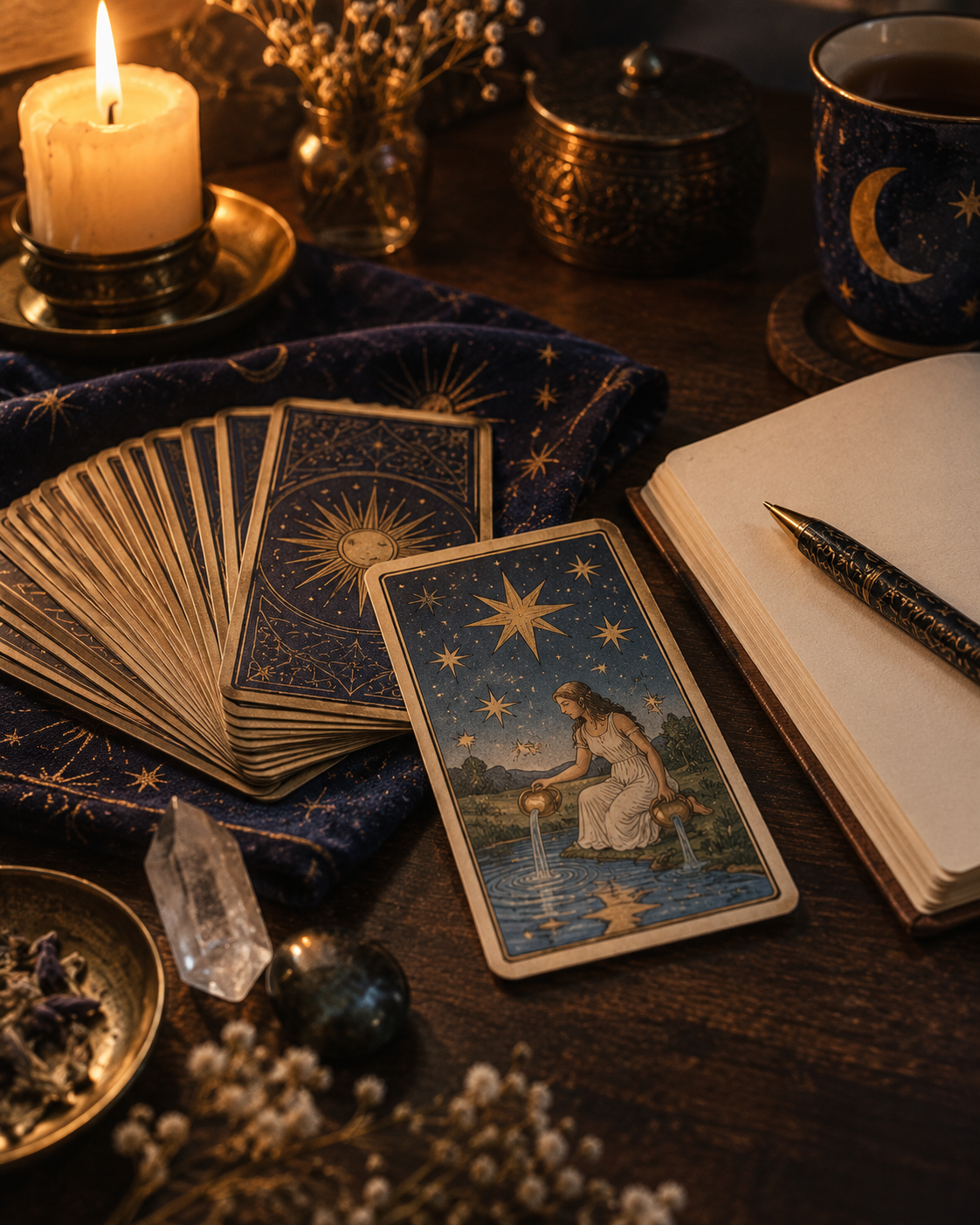
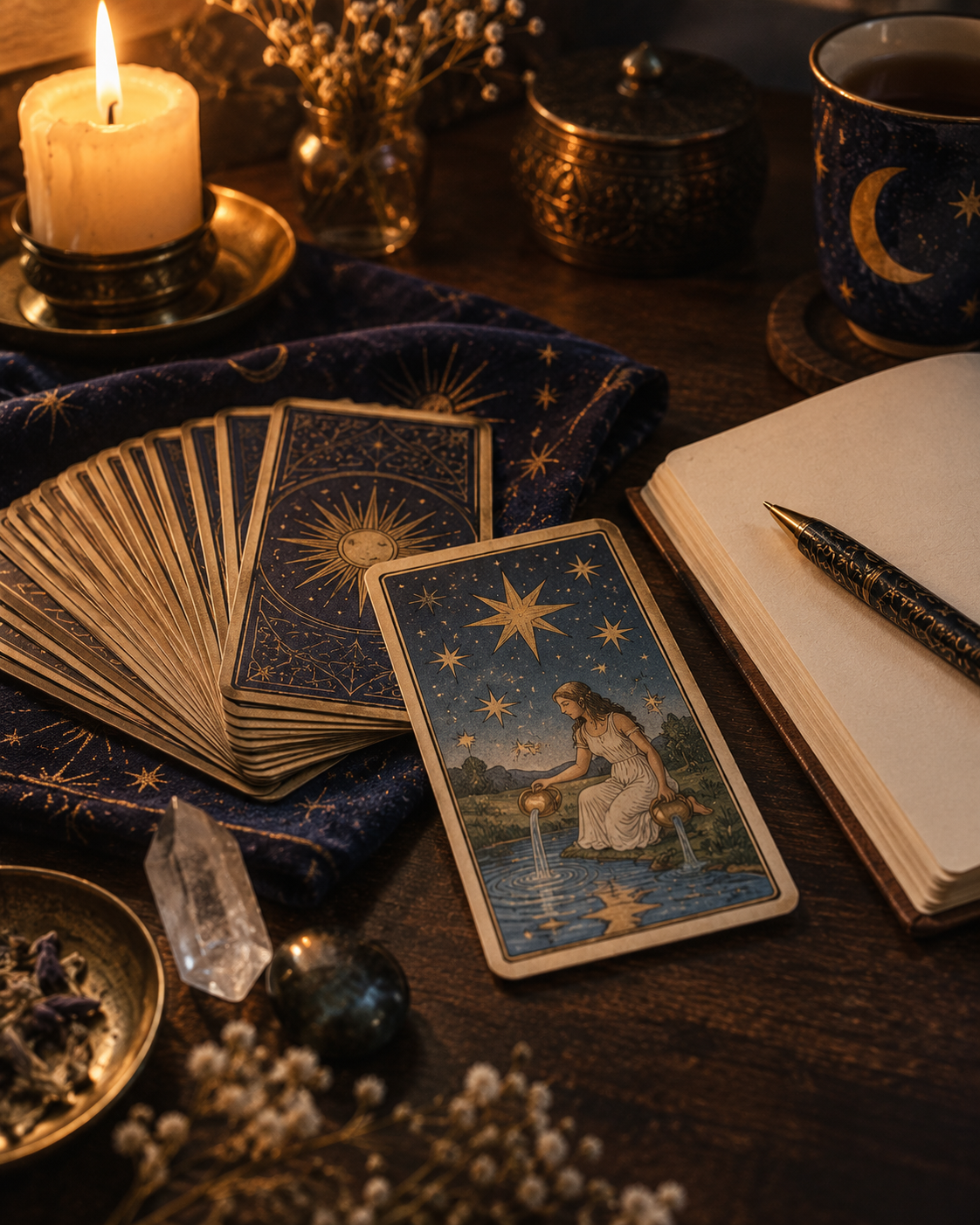
Smith illustrated all 78 cards with full narrative scenes instead. Her Five of Swords shows a figure gloating over defeated opponents in a windswept field. Her Ten of Cups shows a joyful couple beneath a rainbow, children dancing nearby. Suddenly, every single card told a story you could actually read, the way you'd read the expression on a stranger's face or the mood of a room. This is the entire foundation of intuitive tarot reading: you're not reading an abstract symbol system from memory, you're reading a scene, the same way you already read scenes in ordinary life.
It's worth knowing the fuller story too. Smith illustrated all 78 cards in roughly six months, was paid a single flat fee with no royalties, and for decades the deck was credited simply as "Rider-Waite," erasing her contribution entirely. She died in poverty in 1951, never knowing her work would become the most widely used tarot deck in the world. Increasingly, the deck is now properly credited as Rider-Waite-Smith, or RWS. When you read a card intuitively from its imagery today, you're using the exact tool she built specifically to make that possible.
The Intuitive Reading Method: Image, Emotion, Symbolism, Meaning, Context
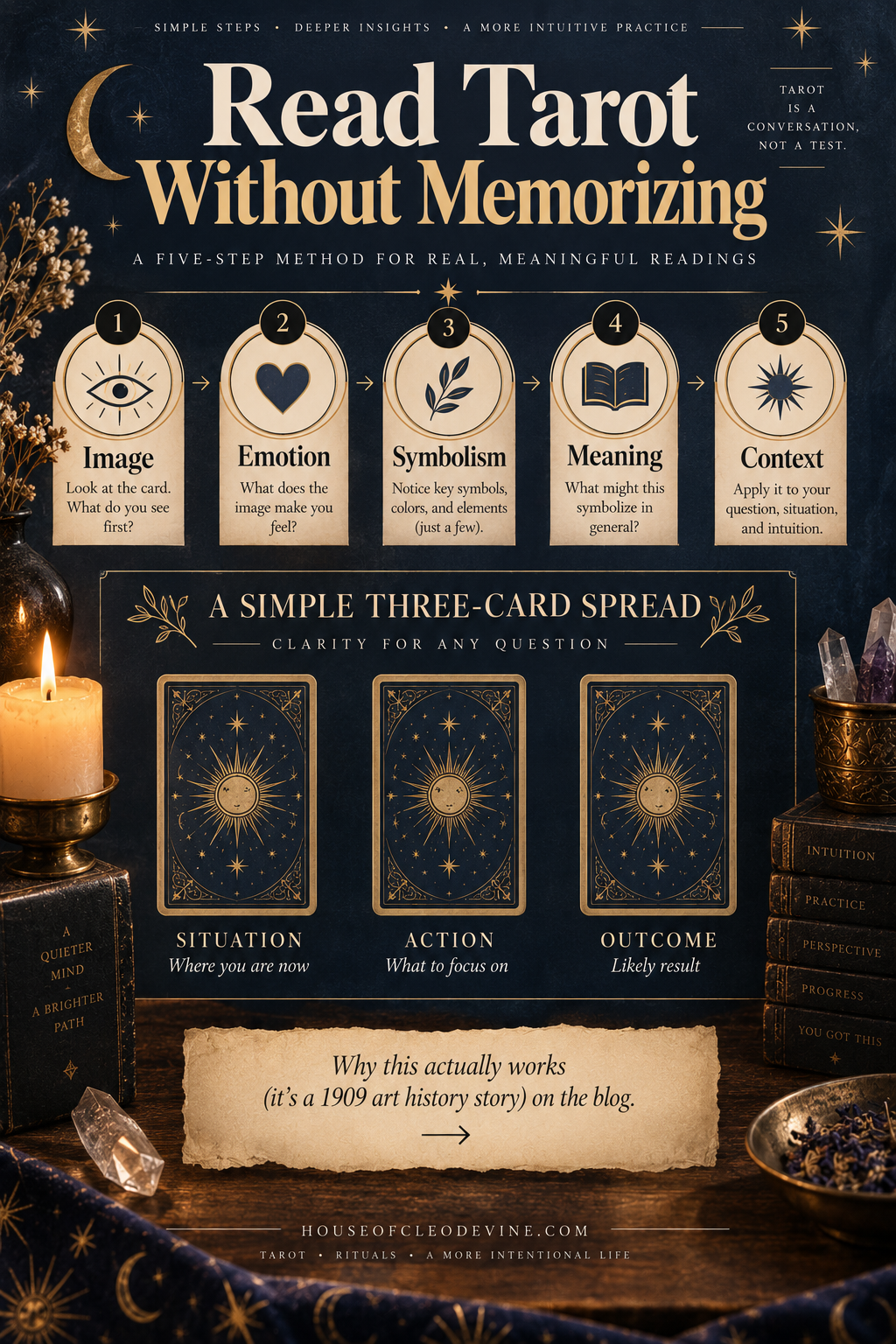
Here's a simple five-step method for approaching any card, using this in order rather than jumping straight to "what does this card mean" from memory.
Image. Before anything else, just look. What's physically happening in the scene? Who or what is present, and what are they doing?
Emotion. What feeling does the image produce in you, before you think about tarot at all? A card showing someone alone on a cliff at night produces a different gut reaction than one showing a full table of friends celebrating. Trust that first response.
Symbolism. Now look closer at specific details, colors, numbers, objects, animals, weather. These carry traditional weight, and noticing them adds depth to your initial read.
Traditional meaning. Only now does it make sense to check what the card is traditionally understood to represent. Used at this point, a reference guide deepens your read rather than replacing it entirely.
Context. Finally, consider the card's position in your spread and its relationship to the cards around it. The same card can shift meaningfully depending on what question you asked and what else appeared alongside it.
Try this with a single card pulled at random before moving to a full spread. Sit with just the image and your emotional reaction for a full minute before checking any reference material at all.
A Simple Three-Card Exercise to Practice Today
This is one of the most accessible spreads for beginners because it maps naturally onto how we already think about a situation.
Card one: the situation. What's actually happening right now, as you currently understand it.
Card two: the action. What's being called for, what movement or choice this moment seems to be asking of you.
Card three: the outcome. Not a fixed prediction, but the likely direction things are heading if the current pattern continues.
Pull one card for each position, and work through the five-step method above for each before looking at how the three relate to each other as a whole story. This single spread, practiced regularly, will teach you more about intuitive reading than memorizing a hundred keyword lists.
Choosing Your First Deck
Your first deck matters more than most beginners realize, because not every deck was built with this intuitive method in mind. Decks based on the Rider-Waite-Smith template, meaning every card, including the Minor Arcana, is fully illustrated, are dramatically easier to learn from than decks with unillustrated pip cards. If a deck's Five of Swords is just five swords arranged in a pattern with no scene, you're back to needing memorization, which somewhat defeats the purpose for a beginner.
My Favorite Tarot Decks for Beginners
The Rider-Waite-Smith Tarot (or a Smith-Waite Centennial edition). The original, and still the foundation nearly all tarot education references. Learning this deck transfers directly to hundreds of others that use the same visual template.
Get a borderless traditional Rider-Waite-Smith deck here →
The Wild Unknown Tarot. A widely loved modern deck with striking, minimalist nature imagery, still built on the RWS structure underneath its distinct visual style.
Get The Wild Unknown Tarot deck here →
Everyday Witch Tarot. A warm, approachable, illustration-heavy deck designed specifically with beginners and everyday practice in mind.
Get Everyday Witch Tarot deck here →
Modern Witch Tarot. A contemporary reimagining of the RWS structure with modern figures and settings, popular for how immediately relatable its scenes feel.
Get Modern Witch Tarot deck here →
Light Seer's Tarot. Known for its emotionally expressive, brightly colored artwork, a favorite among newer readers for how vividly the emotional tone of each card comes through.
Get Light Seer's Tarot deck here →
The Essential Extras. A tarot cloth to designate your reading space, a dedicated journal to record pulls and reflections over time, a small card stand for daily single-card pulls, and a storage bag or box to protect your deck between uses.
When Reading Your Own Cards Gets Hard
It's worth being honest about something here. Reading your own cards about your own life is genuinely harder than reading for someone else, not because the method stops working, but because you're emotionally invested in a particular answer. It's difficult to read a card with real openness when part of you is hoping it says something specific. This isn't a personal failing; it's just a real limitation of self-reading that every experienced reader eventually runs into.
This is exactly where an outside reading becomes genuinely useful, not as a replacement for learning the practice yourself, but as a different vantage point when your own emotional investment makes clear-eyed interpretation difficult. A General Tarot Reading offers that outside perspective for a specific question you're too close to read clearly on your own.
Frequently Asked Questions
Do I need to buy an expensive deck to start learning? No. A well-illustrated deck in the Rider-Waite-Smith tradition, even an affordable printed version, teaches the intuitive method just as effectively as a premium edition. The imagery is what matters, not the price point.
How long does it take to feel confident reading tarot? This varies widely, but consistent daily single-card practice, even just a minute or two using the five-step method, tends to build genuine intuitive fluency faster than occasional long study sessions.
Should I memorize keyword meanings at all, or just rely on intuition? Both together work best. Traditional meanings, checked after your own intuitive read rather than before it, add depth and catch things your first impression might miss, without replacing your own genuine interpretation.
Can I read tarot for myself, or do I need someone else to do it? You can absolutely read for yourself, and most practitioners do this regularly. The limitation is specifically around emotionally loaded questions where your own hope for a particular answer makes objective reading harder, not tarot reading in general.
What's the difference between tarot and oracle cards? Tarot follows a fixed 78-card structure (22 Major Arcana, 56 Minor Arcana across four suits) with consistent symbolism across different decks. Oracle decks have no fixed structure or card count and vary entirely by creator, making them a different, more free-form practice.
Is it true that you shouldn't buy your own first deck? This is a common superstition, but it's not a firm rule most contemporary practitioners follow. Choosing your own first deck, one whose imagery genuinely resonates with you, tends to matter more for actually sticking with the practice than who purchased it.
Tarot was never meant to be a memorization test. It was built, quite deliberately, by an artist whose name was nearly lost to history, to be read the way you already read a room, a face, a scene. Trust that instinct first, let the traditional meanings deepen what you already sense, and the 78 cards stop feeling like a wall to climb and start feeling like a language you're already halfway fluent in.
If you're working through a question that feels too close to read clearly on your own, the General Tarot Reading offers that outside perspective while you keep building your own practice.