

How to Manifest Money: A Spiritual Abundance Ritual for Removing Financial Blocks

Most articles on manifesting money will hand you a vision board and an affirmation script and call it a day. That's not what this is. Money-drawing ritual has a real, documented history that predates the word "manifestation" by well over a century, and it comes with something the vague vibes-only content online tends to skip: an honest boundary around what ritual can and can't do for your finances. Here's a grounded version, rooted in where this practice actually comes from, along with a ritual you can genuinely use.
What "Financial Blocks" Actually Means
The phrase gets used loosely, so it's worth being specific. A financial block generally refers to one of two overlapping things: a psychological pattern, deep-seated beliefs about money formed early in life, scarcity thinking, guilt around receiving, fear of visibility that makes you shrink your own ambition, or, within spiritual practice, an energetic pattern, a sense of stuckness or resistance around money that doesn't seem to respond to effort alone.
These aren't competing explanations. Most people working with money blocks are dealing with both at once: real psychological patterns that ritual alone won't fully resolve, and a felt, energetic stuckness that pure mindset work doesn't always touch either. The most effective approach tends to work with both layers rather than picking one.
The Real History Behind Money-Drawing Ritual
This is where it's worth slowing down, because most content on this topic has no historical grounding at all. Money-drawing rootwork has deep roots in Hoodoo, the African American folk magic tradition that developed among enslaved and later free Black communities in the American South, blending African spiritual practices with Native American herbal knowledge and European folk elements. Prosperity work within this tradition carries real historical weight; for a people systematically denied land, wages, and economic opportunity, the spiritual pursuit of financial stability functioned as an act of self-determination, not idle wishing.
The central figure in Hoodoo prosperity work is High John the Conqueror, a root named for a trickster folk hero from enslaved communities' oral tradition, who outwitted those in power through cunning rather than force. Carrying or working with the root is traditionally understood to lend some of that same resourcefulness to money and business matters. Lodestones, naturally magnetic stones, became a central tool in money-drawing work precisely because of their literal magnetic pull, a physical property doing double duty as spiritual symbolism.
By the early 1900s, Black-owned spiritual supply companies across the South and Midwest were formulating and shipping money-drawing oils nationwide, blends built from alfalfa, cinnamon, fenugreek, patchouli, and vetiver, each chosen for a specific traditional property: alfalfa as the classic money herb, cinnamon to speed the flow of opportunity, vetiver to stabilize what's drawn in so it doesn't slip away as quickly as it came. This entire, well-documented tradition predates modern manifestation culture by generations. Rootworkers were doing this specific kind of intentional, ingredient-based prosperity work long before the language of "abundance mindset" existed.
A Grounded Abundance Ritual for Removing Financial Blocks
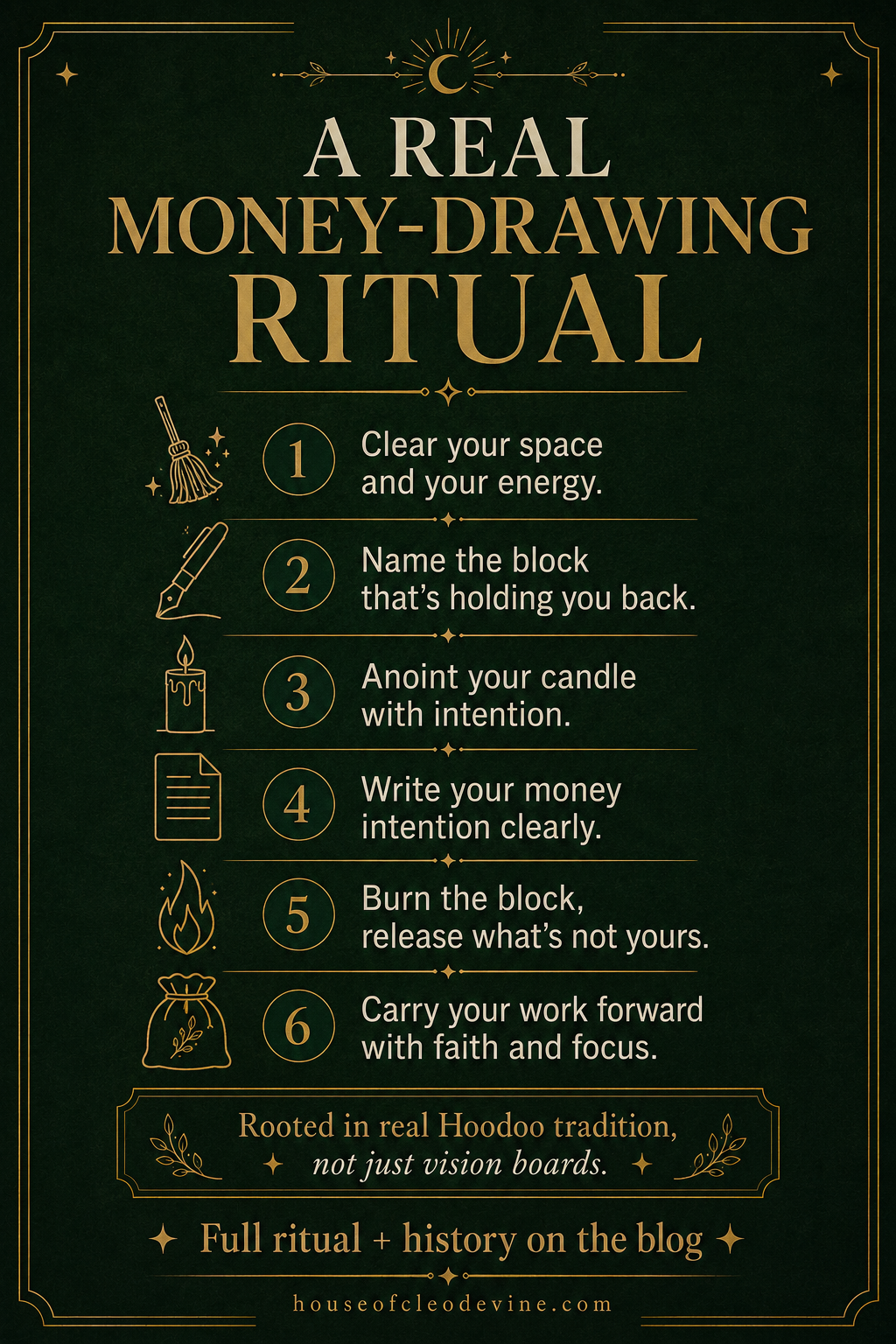
1. Clear the space and yourself first. Before calling anything in, clear what's stagnant. This can be as simple as tidying your physical space, particularly wherever you handle money, wallet, desk, home office, and taking a few minutes to sit quietly and notice what comes up when you think about money without judging it.
2. Name the specific block, not just the general wish. "I want more money" is too vague to work with directly. "I undercharge because I'm afraid of being rejected" or "I avoid looking at my bank account because it makes me anxious" gives you something concrete to actually address, both in ritual and in practice.
3. Anoint a green candle with intention. Traditional practice uses a green candle dressed with a money-drawing oil, worked from the center outward toward each end, while speaking your specific intention aloud. The Money Magnet Prosperity Ritual Oil was formulated for exactly this kind of work, drawing on paying clients, business growth, and new income streams.
4. Write your intention and place it beneath the candle. Naming the specific outcome you're calling in, in writing, gives the ritual a concrete anchor rather than a vague hope, and is a traditional practice across many folk magic lineages, not unique to money work.
5. Let the candle burn fully, with attention. Let it burn down completely if you can do so safely, checking in with the flame periodically rather than lighting it and walking away entirely. This is traditionally understood as part of tending the intention, not just setting it.
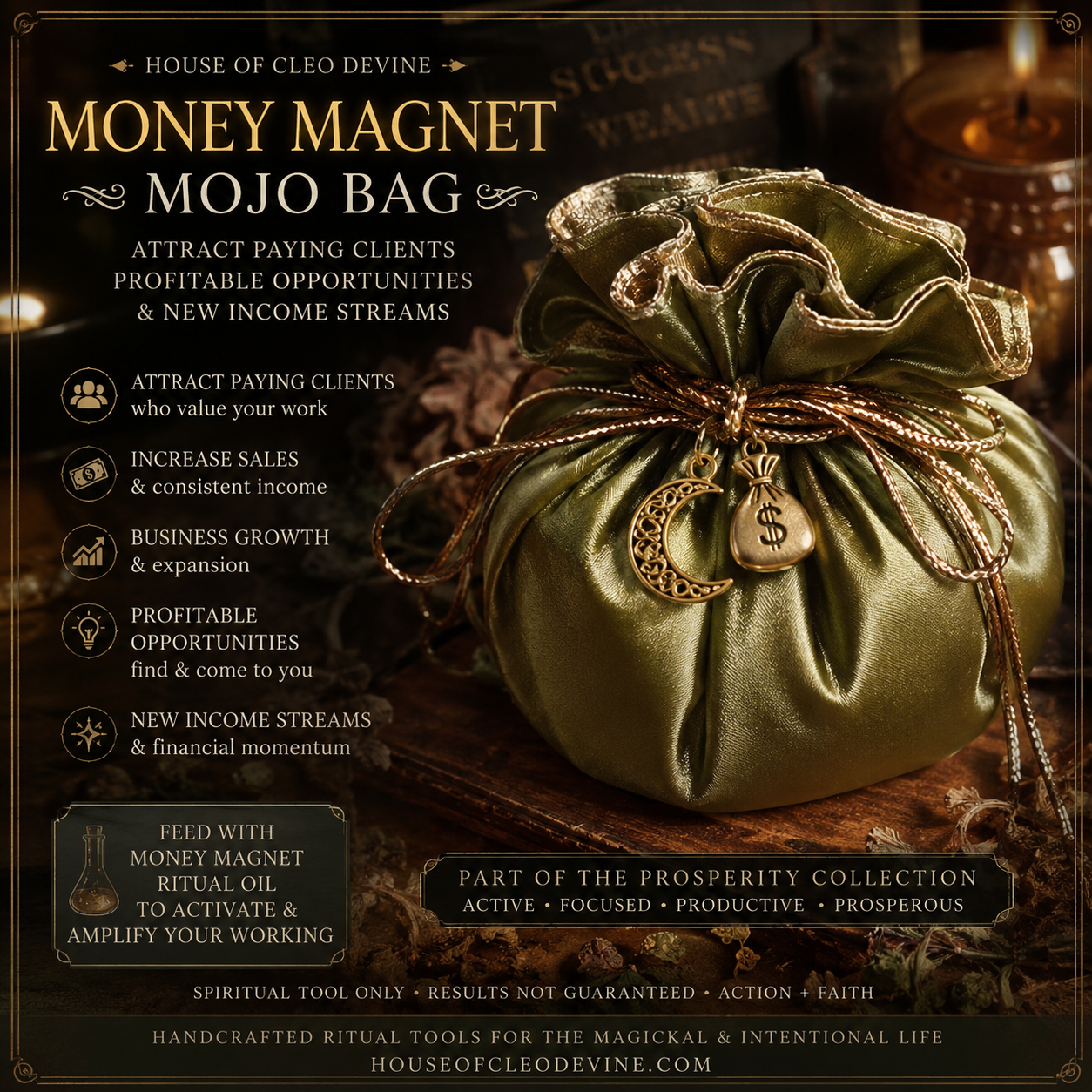
6. Carry the intention forward physically. A dedicated mojo bag, a small handmade sachet built around a single intention, extends the ritual beyond the candle-burning moment into your daily life. The Money Magnet Mojo Bag is built specifically to support paying clients, business growth, and consistent income, and is meant to be carried or kept near where you work.
Building Ongoing Abundance Practice
A single ritual rarely does all the work alone. Traditional practice treats prosperity work as ongoing tending rather than a one-time event: keeping a money-drawing oil on hand to periodically re-anoint your wallet or workspace, wearing a piece of jewelry that keeps the intention present through your day, and returning to your named block regularly rather than only when things feel urgent. The Self Made Millionaire Crystal Bar Necklace combines green aventurine and citrine specifically for this kind of sustained, everyday abundance intention, keeping the work present in ordinary moments rather than confined to a single ritual night.
What Manifestation Can't Do
This matters enough to say plainly. No ritual, oil, jewelry, or spellwork guarantees a specific financial outcome, replaces real-world financial action, or substitutes for practical steps like budgeting, negotiating fairly, seeking new income streams, or addressing debt directly. Spiritual practice in this tradition has always worked alongside real-world effort, not instead of it; the historical record on rootwork is explicit that intention paired with action was the actual expectation, not intention alone.
If deep financial anxiety, compulsive spending, or persistent inability to manage money regardless of income is part of what you're carrying, that's worth bringing to a financial counselor or therapist alongside, not instead of, any spiritual practice. Ritual can support the mindset and energetic layer. It isn't a substitute for professional guidance where that's genuinely needed.


Frequently Asked Questions
How long does it take for a money ritual to work? There's no fixed timeline, and traditional practice generally emphasizes ongoing tending over a single dramatic result. Some people notice shifts in mindset and small opportunities within days; more significant financial changes typically unfold over weeks or months, often alongside real-world action taken in that same window.
Do I need to believe in Hoodoo specifically to do this ritual? No. You can approach this work with genuine spiritual conviction, general openness, or simply appreciation for a historically grounded practice. What matters most is clear intention and consistent follow-through, not a specific belief system.
Is it appropriate to use Hoodoo-rooted tools if I'm not part of that tradition's cultural lineage? This is worth real thought rather than an easy answer. Many practitioners, including within House of Cleo Devine's Southern folk magic practice, work respectfully within blended folk traditions while being explicit about where specific practices originate, as this article has tried to do, rather than presenting them as generic, unsourced "witchcraft."
Can I do money-drawing ritual if I'm currently in debt? Yes, and many traditional workings specifically address debt and financial recovery rather than only growth from a stable position. Naming your specific situation honestly, debt relief, stabilizing income, building an emergency fund, tends to work better than a vague wish for generic wealth.
What's the difference between a mojo bag and a ritual oil for money? A ritual oil is generally used to anoint candles, objects, or yourself during active ritual work. A mojo bag is meant to be carried continuously, extending the intention into your daily life between rituals rather than being used once and set aside.
Should I repeat this ritual regularly, or is once enough? Traditional practice generally favors ongoing tending, periodically re-anointing, refreshing a mojo bag's contents, or repeating the candle ritual, rather than a single working expected to carry indefinitely on its own.
Money ritual, done with real historical grounding and honest expectations, is a genuine practice, not a substitute for the practical work of managing and growing your finances. Name your specific block, work the ritual with real attention, and carry the intention forward into ordinary days rather than treating it as a one-time event.
If you're ready to start, the Money Magnet Prosperity Ritual Oil and Money Magnet Mojo Bag work well together for the ritual above, and the Self Made Millionaire Crystal Bar Necklace helps carry the intention into your everyday life afterward.
Further Reading From House of Cleo Devine
Energy Cleanse vs. Cord Cutting: What's the Difference and When to Use Each
Manifest Your Desires – Spiritual Coaching for Alignment, Clarity & Abundance