

5 Myths About Kitchen Magic (And What Southern Folk Magic Actually Teaches)
Someone in your life has probably raised an eyebrow at the idea of kitchen magic. Maybe they pictured candles, chanting, or something dark and secretive. Maybe you have felt that same hesitation yourself, wondering if you are "doing it wrong" or if this practice is even meant for someone like you.
Most of what people believe about kitchen magic and Southern folk magic is wrong, or at least seriously incomplete. These myths keep curious, sensitive women from ever giving themselves permission to start. It is time to clear the air.
Kitchen magic is a simple, intention based practice that uses everyday cooking to support real life goals like protection, healing, and clarity, and it requires no special gift, expensive tools, or secret initiation to begin. Once the myths are cleared away, what is left is something far more accessible than most people expect.
What Is the Biggest Myth About Kitchen Magic?
The biggest myth about kitchen magic is that it requires expensive tools, rare ingredients, or a dramatic ritual setup to actually work. In truth, Southern folk magic and Hoodoo were built by people with very little money or access to specialty items. The entire tradition grew out of resourcefulness, using ordinary kitchen items with real intention behind them.
This single myth stops more beginners than almost anything else. Once it is cleared away, kitchen magic becomes something anyone with a stove and a spice cabinet can start tonight.
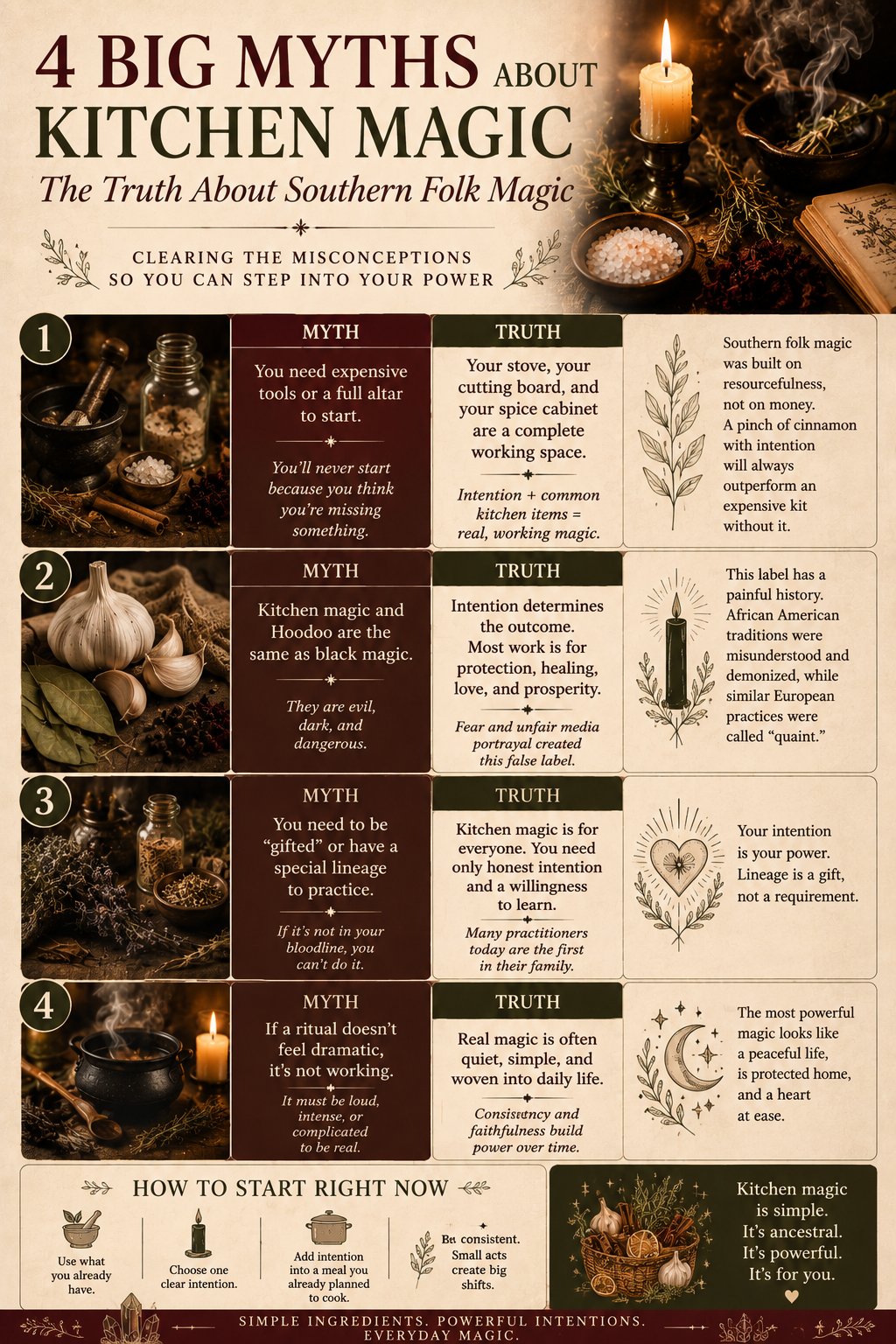
Myth 1: You Need Expensive Tools or a Full Altar to Start
This myth keeps so many women stuck before they even begin. They imagine they need a dedicated altar room, rare crystals, or an expensive spell kit before their practice can "count."
The truth is simpler and more powerful. Your stove, your cutting board, and your spice cabinet already form a complete working space. A correspondence guide and a pinch of cinnamon will always outperform an expensive kit used without real intention behind it.
Southern folk magic developed among people who often had very little material wealth, especially during and after slavery. The tradition survived precisely because it did not depend on money or access to specialty shops. A wooden spoon, a cast iron pot, and a handful of common herbs were, and still are, more than enough.
Myth 2: Kitchen Magic and Hoodoo Are the Same as Black Magic
This myth causes real harm, and it deserves a direct answer. Southern folk magic and Hoodoo are not inherently evil, dark, or dangerous. Like any tool, intention determines the outcome, the same way a knife can prepare a healing meal or cause harm depending on who holds it and why.
Most Hoodoo and kitchen magic work centers on protection, healing, love, and prosperity, not harm. The "black magic" label often comes from fear of the unfamiliar, along with decades of unfair media portrayal, rather than the actual practice itself.
It also matters to say plainly that this label has a painful history. Traditions built by African American communities have often been unfairly labeled as sinister simply because they were misunderstood by outsiders, while very similar European folk practices were treated as quaint or harmless. Recognizing this double standard is part of approaching Southern folk magic with real respect.
What Is the Difference Between Hoodoo and Voodoo?
Hoodoo and Voodoo are related but distinct, since Voodoo is an organized African traditional religion requiring initiation, while Hoodoo is a folk practice, not a religion, built around herbs, prayer, and practical spiritual work. Many people confuse the two because both trace back to African spiritual roots, but they developed differently and serve different purposes.
Understanding this difference matters, especially if you want to speak about these traditions accurately and respectfully.
Myth 3: You Need to Be "Gifted" or Have a Special Lineage to Practice
This myth quietly convinces so many curious women to never even try. They believe they need psychic ability, a family lineage of practitioners, or some innate spiritual gift before kitchen magic is "allowed" for them.
Kitchen magic has always been deeply personal and accessible. You do not need a special title or bloodline to light a candle with intention or add a protective herb to a meal. What matters is honest intention and a willingness to learn, not a rare inherited gift.
If you do come from a family line of practitioners, that is a meaningful gift, but its absence does not disqualify you. Many dedicated practitioners today are the first in their family to learn this work openly, often because earlier generations had to keep it hidden or quiet out of necessity.
How Do I Start Practicing Kitchen Magic Without Expensive Tools?
You start by using items already in your kitchen, choosing one clear intention, and adding it into a meal you were already planning to cook, without buying anything new. Salt, cinnamon, garlic, and bay leaf cover an enormous range of intentions on their own.
A simple Southern Folk Magic Correspondence Guide helps you match what you already own to the intention you want to work with, so you never feel like you are missing a required tool.
Myth 4: If a Ritual Does Not Feel Dramatic, It Is Not Working
This myth comes from movies and social media, where magic is shown as instant and visually dramatic. Real kitchen magic rarely looks like that. It tends to feel quiet, steady, and cumulative rather than immediate and flashy.
A calmer mood after a meal, a small shift in a stressful situation, a sense of grounded clarity, these are signs of real, working magic. They are simply quieter than what movies have trained us to expect.
How Do I Know if My Kitchen Magic Ritual Is Actually Working?
You know it is working when you notice small, steady shifts over time, like feeling calmer, more grounded, or seeing gradual movement toward your intention, rather than expecting one dramatic instant result. Keep a short journal noting your intention and what you observe afterward. Patterns become clear over weeks, not single sessions.
Real change in folk magic tends to build quietly, the same way trust or a habit builds, one small repetition at a time.
Myth 5: Kitchen Magic Is Just Aesthetic, Not Real Spiritual Work
Social media has turned kitchen witchery into a visual trend for some, all candles and pretty jars with no substance behind it. This has led some people to dismiss the entire practice as empty aesthetic.
Real kitchen magic, especially rooted in Southern folk tradition, carries deep history and real spiritual weight behind it. The aesthetic can be part of the experience, but it was never the point. The intention and lineage behind the practice are what make it real.
A pretty jar of herbs with no intention behind it is decoration. The same jar, used with a clear purpose and real attention, becomes a working tool. The difference is invisible from the outside but everything on the inside.
Why Do People Assume Folk Magic Is Evil or Dangerous?
People often assume folk magic is evil or dangerous because of unfamiliarity, decades of sensationalized media portrayals, and historical fear of traditions built by marginalized communities, particularly African American Hoodoo practitioners. Fear of the unknown tends to attach itself to whatever looks unfamiliar or is poorly understood by the mainstream.
Understanding the real history and intention behind these practices, rather than relying on movies or secondhand rumors, clears up most of this fear quickly.
Should I Worry if My Kitchen Magic Does Not Feel Dramatic or Instant?
No. Slow, quiet results are actually a sign of authentic practice, since real folk magic tends to work gradually through consistency rather than instant, dramatic transformation. Worrying about a lack of drama often causes beginners to quit right before they would have noticed real, steady progress.
Give any new practice at least a few weeks of consistent, small effort before judging whether it is working for you.
What Are Other Small Myths Worth Mentioning?
A few smaller myths deserve a quick word too. Some believe kitchen magic only counts if you grow your own herbs, which simply is not true, since store bought herbs used with intention work just as well. Others believe you have to practice every single day or the magic stops working, when in reality consistency matters far more than frequency. A weekly practice done with real presence outperforms a daily practice done on autopilot.
A Quick Myth Check List
Use this list any time doubt creeps in about your own practice.
You do not need expensive tools, only intention and a few kitchen basics
Kitchen magic and Hoodoo are not inherently evil or dangerous practices
You do not need a special gift or bloodline to begin
Quiet, gradual results are a sign of real magic, not failed magic
Real practice carries meaning beyond aesthetic or trend
Come back to this list whenever a myth starts to creep back into your thinking.
What Should I Tell Family or Friends Who Do Not Understand This Practice?
You do not owe anyone a full explanation or defense of your practice. A simple, honest sentence usually works best, something like "I cook with intention, the same way my grandmother did." You are allowed to keep parts of this practice private, especially with people who are not likely to approach it with an open mind. Protecting your own peace matters more than convincing every skeptic in your life.
Practicing With Confidence Instead of Doubt
Once these myths are cleared, kitchen magic starts to feel less intimidating and more like something you already know how to do. You already cook. You already care for the people around you. You already notice which foods bring comfort during hard weeks. That instinct is the beginning of real practice.
Southern folk magic was never meant to feel exclusive or complicated. It was built by everyday people using everyday tools, and it remains just as accessible today.
One Last Thing Worth Remembering
Doubt tends to come back in waves, even after the myths feel cleared. That is normal, not a sign you have failed. Each time doubt shows up, treat it the same way you would treat a stubborn stain on the stove. You do not panic over it. You simply clean it up again and keep cooking. Confidence in this practice is built the same way any skill is built, through repetition, patience, and a willingness to keep showing up even when a small doubt tries to creep back in.
If you want a clear, beginner friendly reference that clears up correspondence confusion the same way this post clears up myths, the Southern Folk Magic Correspondence Guide is built exactly for that purpose.
Ready to stop second guessing yourself and start practicing with confidence? Grab the Southern Folk Magic Correspondence Guide and let go of the myths holding you back.