

The Loneliness of Being an Empath: Why You Feel Misunderstood and What to Do

There is a kind of loneliness that has nothing to do with being physically alone. It is the loneliness of sitting in a room full of people who love you and feeling like not one of them truly knows what it is like to be you. Of laughing at the right moments and saying the right things and going home afterward feeling emptier than when you arrived. Of wanting, desperately, to be truly seen, and not knowing where to find someone who has the capacity to see you at the depth you actually exist.
If you are an empath, this loneliness is not incidental to your experience. It is one of the most consistent and most quietly devastating aspects of living with the level of sensitivity you carry. And it is almost never talked about with the honesty it deserves.
This post is for every empath who has ever felt like an alien in their own life. Who has wondered whether something is fundamentally wrong with them because connection, which should be the easiest thing in the world for someone who feels as deeply as they do, so often feels impossibly hard to find in any real and lasting form.
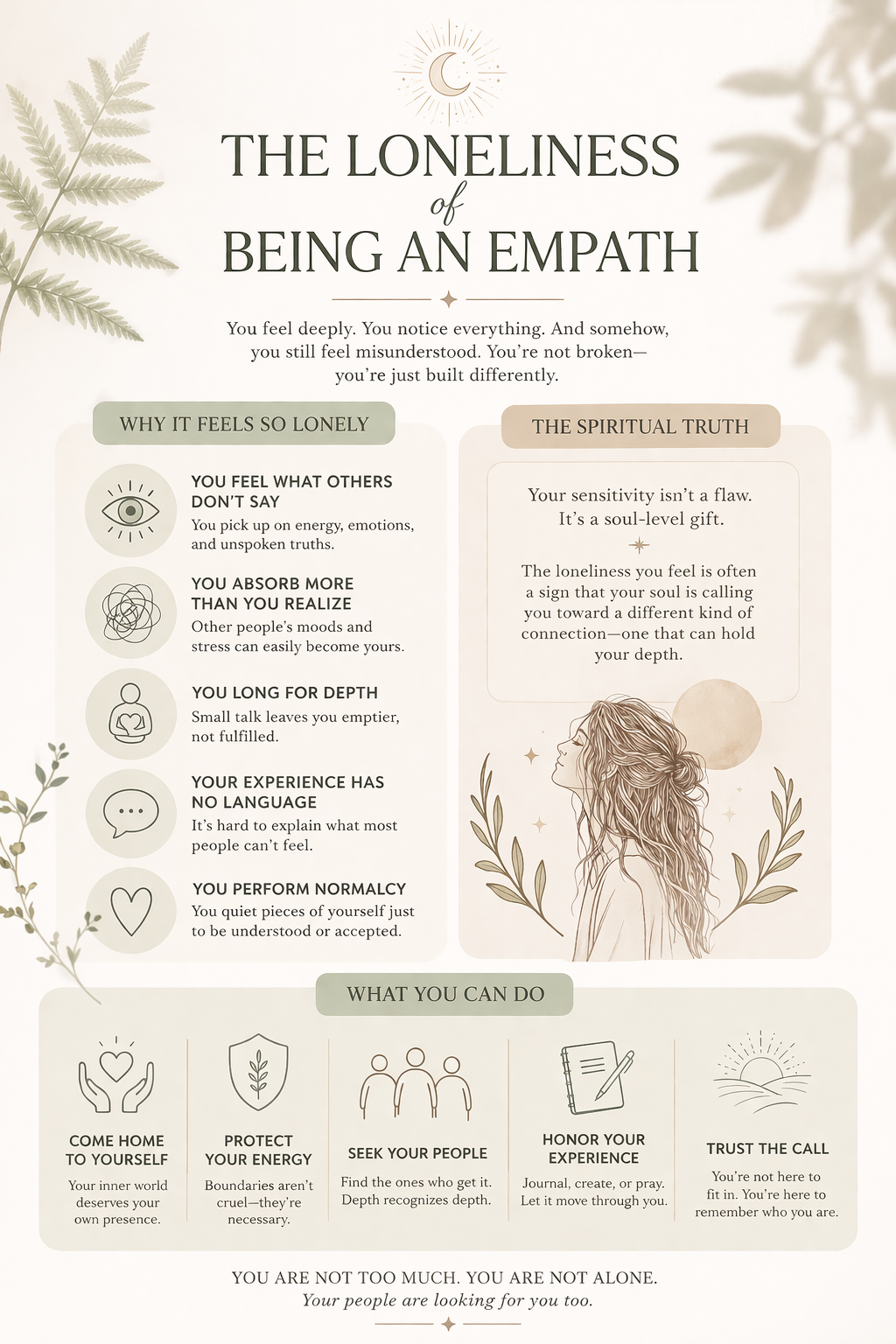
You are not broken. You are not too much. And you are not as alone in this experience as it currently feels.
The Particular Loneliness That Comes With Feeling Everything
Most people assume that empaths, because they feel so deeply and connect so naturally, must have rich and satisfying relational lives. From the outside, many empaths do appear this way. They are warm, attentive, easy to talk to, and genuinely interested in the people around them. They attract others effortlessly.
What those others rarely see is what happens inside the empath during and after those connections. The exhaustion of holding so much. The quiet ache of giving deeply and receiving surface-level in return. The specific grief of knowing someone's inner world with extraordinary intimacy while feeling that your own inner world remains largely invisible to them.
Why You Can Be Surrounded by People and Still Feel Completely Alone
Empath loneliness is paradoxical because it is not solved by the presence of other people. In fact, for many empaths, being around people amplifies rather than alleviates the loneliness. You are so busy feeling everyone else's experience, managing the energetic field of the room, monitoring emotional undercurrents, and holding space for what others are not saying that there is often no room left for your own experience to be present, let alone witnessed by anyone else.
You can spend an entire evening in genuine, warm connection with people you care about and come home feeling profoundly unseen. Not because anything went wrong. But because the depth at which you exist was never quite reached. The conversation stayed at the surface. The connection was real but thin. And you are hungry for something thicker, something that can actually hold the full weight of who you are.
Why Empaths Feel So Deeply Misunderstood
The misunderstanding that empaths experience is not usually malicious. The people in their lives are rarely trying to dismiss or minimize them. What is happening is more fundamental than that, and in some ways more painful because of it.
When Your Experience Has No Language in the People Around You
Most empaths are navigating a form of inner experience that the majority of people around them simply do not have access to. When you try to explain that you felt the grief in a room before anyone said a word, or that you came home carrying your colleague's anxiety in your chest, or that you cannot watch certain films because you absorb the characters' pain as your own, you are describing a reality that has no frame of reference for people who do not share it.
The response you often receive, even from people who love you, is well-intentioned but falls short. You are told you are overthinking. That you are too sensitive. That you need to toughen up, detach, stop taking things so personally. The advice is not wrong for a different kind of person. But it does not address what you are actually experiencing, and the gap between what you are trying to communicate and what lands creates a particular kind of isolation that accumulates over time.
You learn, often very early, to stop trying to explain. To translate your experience into something more palatable and comprehensible to the people around you. To make yourself smaller and more legible. And in doing so, you gradually disappear, not to them, but to yourself. And the loneliness deepens.
The Exhaustion of Performing Normalcy
Many empaths carry a specific kind of fatigue that is rarely named: the exhaustion of performing a version of yourself that is manageable for the people around you. Of laughing off your sensitivity. Of pretending you did not notice what you clearly noticed. Of going along with conversations and environments and dynamics that your entire being is registering as deeply uncomfortable while your face remains pleasant and agreeable.
This performance is not dishonesty. It is survival. And it is extraordinarily costly. Because every moment you spend performing normalcy is a moment you are not actually present in your own experience, which means you are not available for the genuine connection you are simultaneously aching for.
The Spiritual Root of Empath Loneliness
Beyond the relational and psychological dimensions of empath loneliness, there is a spiritual layer that deserves direct attention, because for many empaths the loneliness is not just about relationships. It is about the experience of being at a particular level of spiritual awareness in a world where that level is not widely shared.
When You Are Awake in a Room Full of Sleeping People
Many empaths are highly spiritually aware, whether or not they use that language to describe themselves. They sense the energetic undercurrents of situations. They know things without knowing how they know. They perceive dimensions of reality, emotional, psychic, and energetic, that are not part of the mainstream framework most people use to navigate life.
This creates a very specific kind of loneliness. The loneliness of seeing what others do not see. Of knowing what others are not ready to know. Of caring about things that the people around you regard as unimportant or strange. Of living at a frequency that most of your immediate environment is not tuned to.
This is not superiority. It is not a judgment of others. It is simply the experience of existing at a particular level of awareness that has not yet found its community, and the ache of that unresonated knowing is one of the loneliest feelings there is.
How Spiritual Awakening Deepens the Sense of Isolation
For empaths who have gone through or are moving through a significant spiritual awakening, the loneliness often intensifies before it softens. Awakening changes your relationship to reality in ways that are profound and often disorienting, and it frequently creates a gap between you and people who were previously close to you.
Your values shift. Your priorities reorganize. Things that once mattered deeply become less important, and things that were invisible to you before become centrally significant. This reorganization is necessary and ultimately beautiful, but it often means that existing relationships no longer fit in the same way, and new ones that genuinely resonate have not yet been found.
If you are in this space right now, the loneliness you feel is real and it is valid. It is also temporary, not in the dismissive sense of just wait it out, but in the genuine sense that the path of awakening, when walked with intention and support, leads toward connection of a depth and authenticity that was simply not possible before.
The Ways Empaths Respond to Loneliness That Make It Worse
Understanding how empaths typically respond to loneliness is important because several of the most common coping patterns actually deepen the isolation rather than resolving it.
Over-Giving as a Substitute for Genuine Connection
When you are starving for genuine connection and cannot find it, the empath's most common substitute is over-giving. You pour yourself into other people's needs. You become indispensable. You create a form of closeness through caretaking that feels like connection but is actually a way of avoiding the vulnerability of being truly seen yourself.
Over-giving keeps you at the center of other people's lives while simultaneously keeping your own inner life safely out of reach. It is lonely in a specific way, the loneliness of someone who is always present for others and never quite present for themselves.
Isolation as Self-Protection
The opposite pattern is also common. Having been burned by the exhaustion of over-giving or the disappointment of shallow connection, many empaths withdraw entirely. They create lives of deliberate solitude, which can feel like relief initially but gradually becomes its own form of loneliness, the loneliness of someone who has stopped trying.
Solitude is genuinely nourishing for empaths. Isolation is not. The difference is whether the time alone is chosen from a place of self-knowledge and genuine need, or whether it is chosen from fear, resignation, or a belief that real connection is simply not available to you.
Attracting the Wrong People Out of Hunger for Depth
Perhaps the most painful pattern of all is the way empath loneliness can drive them toward intensity as a substitute for depth. When you are hungry for genuine connection and you encounter someone who brings drama, crisis, or overwhelming emotional need, it can feel like depth. The intensity of it activates you. It gives your sensitivity somewhere to go.
But intensity is not depth. And the relationships that form from this hunger tend to be the very ones that drain the empath most severely, because they offer the feeling of being needed without the experience of being truly known.












What Empaths Actually Need to Feel Less Alone
Understanding what genuinely addresses empath loneliness, rather than what temporarily numbs it, is the foundation of building a relational life that actually works for your nature.
The Difference Between Solitude and Isolation
Intentional solitude is one of the most important and most nourishing practices available to empaths. Time alone, genuinely alone, without the background noise of other people's energy fields, is not just pleasant for empaths. It is necessary for energetic recalibration, for hearing your own thoughts, for reconnecting with your own desires and knowing.
The practice is in learning to inhabit solitude as a resource rather than a refuge from defeat. When you choose solitude from a place of self-knowledge, it replenishes. When you choose it from a place of giving up on connection, it depletes in a different way than company does.
Knowing which one you are doing in any given moment is important information.
Finding and Recognizing Your People
Empath loneliness is real, but it is not permanent and it is not total. There are people in the world who can meet you at the depth at which you exist. Finding them requires knowing what genuine resonance feels like and being willing to keep looking until you find it.
Genuine resonance with another person feels fundamentally different from the anxious over-connection of a trauma bond or the exhausting work of a one-sided relationship. It feels like relief. Like being able to exhale fully. Like you do not have to translate yourself. Your experience makes sense to them because they are navigating their own version of the same terrain.
These people exist. They are often found in spiritual communities, in healing spaces, in circles organized around depth and genuine self-inquiry rather than performance and social maintenance. They are worth looking for with genuine intention.
The Role of Spiritual Community in Empath Healing
For empaths whose loneliness has a significant spiritual dimension, finding genuine spiritual community is often the most transformative shift available. Being in the presence of people who share your sensitivity to energy, who use the same language for the same experiences, who validate your perception of reality rather than questioning it, creates a form of belonging that nothing else quite replicates.
This does not require a formal religious community. It might be a small group of people who gather for healing work. A circle of practitioners or seekers. An online community built around genuine spiritual depth. The form is less important than the quality of resonance it offers.
How to Build a Life That Honors Your Depth Without Isolating You
Building a life that works for your nature as an empath requires intentionality in a few specific areas.
Choosing quality over quantity in your relationships. Two or three relationships of genuine depth will nourish you more than twenty relationships of pleasant surface connection. Give yourself permission to invest your relational energy where genuine resonance is present rather than spreading it thin across connections that feel obligatory or comfortable but not truly nourishing.
Creating regular energetic clearing practices so that the exhaustion of social interaction does not become the defining experience of your relational life. When you are consistently clearing what you absorb, connection becomes something you can genuinely look forward to rather than something you have to recover from.
Being honest about your experience in relationships that have the capacity to hold it. The loneliness of feeling unseen is partly a function of not showing yourself. Not every relationship has the capacity for the depth you carry, and that is okay. But in the ones that do, practicing genuine self-disclosure, sharing what you actually experience rather than the translated, palatable version, is how those relationships deepen into the real connection you are seeking.
Working with your spiritual path actively rather than navigating it alone. Whether through a spiritual mentor, an energy healer, a therapist who understands sensitivity, or a community of like-minded seekers, having support on the path makes the lonelier stretches of it genuinely more bearable and significantly shorter.
You Were Not Meant to Walk This Path Alone
The loneliness of being an empath is real. It is not imagined, it is not drama, and it is not evidence of a flaw in your character or your capacity for connection. It is the natural consequence of carrying a level of sensitivity and awareness that has not yet found its full community and context.
But you were not given this depth so that you could carry it in isolation. You were given it so that you could find the people, the practices, and the path that can actually meet you in it. So that the sensitivity that has so often felt like a burden could become what it was always meant to be, a bridge between you and a kind of connection that most people never get to experience.
That connection exists. The path toward it begins with honoring exactly who you are, not despite the depth you carry, but because of it.
Ready to Feel Less Alone on This Path?
If empath loneliness is something you are navigating right now, House of Cleo Devine offers a space where your sensitivity is not just understood but honored. Our spiritual coaching provides one-on-one support for empaths working to build lives and relationships that genuinely work for their nature. Our intuitive readings offer clarity and guidance for those in periods of spiritual awakening or significant transition.
You do not have to figure this out alone. Support that actually understands what you are navigating is here.